Snow is dropping sparse but heavy and wet this afternoon, tapping against leaves and the pages of my open notebook, moistening my sweatshirt.
The snow goes out soggy and white, eroding away from the upper surfaces of logs, leaving patches beneath knots on the white oak trunks where branches have broken away. Melted snow or raindrops hang from the ironwood branches beside marcescent leaves. It is hard to distinguish right now whether the snow is falling and melting or whether these drops are just rain falling. Perhaps I am passing between snow and rain as I walk, with warm cells the size of houses circulating above the treetops in the otherwise-just-freezing air.
A large squirrel races across the trail at full tilt, leaps onto a white oak and shelters behind it, head down. As she does so, I am distracted by the sound of two somethings calling from the other side of the hill that flanks the ephemeral pond in the middle of Maple Grove. What are they? They might be red-bellied woodpeckers, but that’s not correct. They are too strident and high-pitched. The squirrel jumps off the oak and bounds across to another tree nearby and races up it and is gone from sight.
Then the somethings come over the hill. They are small dogs, one like a Pomeranian and the other like I don’t know what. They career around the trees yipping and barking, and I hear their owner calling to them. His head bobs into view over the hill. He shouts an apology from a distance. We smile at each other. No need to apologize. That’s dogs.
Then the dogs meet up at a single tree and are barking with particular intensity at something above them. It is the squirrel I watched a minute earlier, or one of her friends, someone of similar girth and length, 30 feet up in a sugar maple. The dogs are giving the squirrel no rest. They feel they have treed her, given her no options, and everyone should know. Perhaps they will get the beast today, despite the fact that they never get a squirrel, no matter how hard they try. The squirrel is unconcerned. She watches them. She starts to climb. Then she loses her footing. She falls from her position higher than the highest point of our house and lands on her back in the leaf litter, bounces just a bit. The dogs are on her in a fraction of a second, and I am certain she’s a goner. But the squirrel is too fast. She has twisted her body around and scampers up a nearby tree before the dogs can get her. I can hardly keep her in view as she runs away.
The squirrels chatter excitedly in their last few minutes of daylight on New Year’s eve. This day probably does not mean anything more or less to them than any other day of the year. On the walk home, I jump over a curb and my toe catches, and I sprawl on the ground. I am unhurt and pick myself up quickly, but not so quickly that those dogs wouldn’t have gotten their horrible little teeth into my calf and dragged me down. I think of myself as a reasonably competent human being in spite of this stumble. I would not last one week as a squirrel.
I’ll have memories of moments like this from the 55th year of my life when I am 90. The squirrels may not. One of their members has escaped death once again. Did she realize it as it was happening, much less remember it at the end of the day? As she chatters with her friends this New Year’s day, will she tell them she loves them with just a little more emphasis than usual? Will she express or even consider how grateful she is to have made it through one more season in her magnificent forest? How she loves to climb trees? How good it is to have this good strong body and limber backbone that lets her bounce—bounce!—after falling half the height of a tree into the pockmarked snow, and elude two ferocious little dogs?
I suspect not. We’ll have to do it on her behalf. Happy New Year, friends and family.
The footpath off the main trail is stamped with the footprints of perhaps a dozen walkers since last night’s snow. Along the trailside are frozen walnuts with husks desiccated and brown, pock-marked in a state of semidecay, chewing marks here and there. They look like the brown-wrapped mummies of an Egyptian museum exhibit.
Two birds are calling at about 40 feet up in the trees around me, but I cannot recognize the sound. I stop, watch for them, find one moving on a leaning white oak. It is a red-headed woodpecker, puffed up in the cold, picking methodically at a bend in the tree where, perhaps, a branch broke off and there is a notch where beetle larvae are overwintering, or caterpillars. It works its way in from both sides, turning its head and striking a few times, pulling back to look around, moving its bill as though swallowing, strikes again. Its bill looks as slender as surgical forceps from where I stand, though the photos I find online later make it look nowhere near as fine an instrument. It flies off and I lose it. A red-bellied woodpecker barks and a white-breasted nut hatch calls.
The snow throws everything into contrast. Between the forest and the marsh I run across a knot of catalpas I had forgotten about. One is two trunked, low, and gnarled, a kindergartner’s dream of a witch’s tree. It dangles slender capsules over the trail, each nearly as long as my forearm, a Christmas tree festooned in pencil-thin, tibia-length beans. A posse of robins flies by, alternately flapping and gliding as they ride the shoulder past me on the trail, chatting and chuckling their way to a dead tree overlooking the marsh. Two of them swoop upward to recline in the tree, one taking the very topmost branch tip, the other the tip of a branch below. They are uncouth, but they are probably good-hearted. They are a bit cavalier. The others glide down into the brush below.
Two red berries the size of mung beans hang on a bare honeysuckle. They are not quite frozen hard, the sugars inside keeping their pulp slushy. Two-footed robin tracks follow the trail to meet the tracks of a rabbit and squirrel at the foot of a bench, all winding around looking for food of some kind that I cannot see. I walk out onto the boardwalk floating at the edge of the marsh, and it cracks through the ice and sinks by an inch. Two geese honk as they fly over the open marsh.
A husked, eviscerated black walnut is lodged in the burl of a black cherry that is leaning over the forest trail. The cherry’s roots are exposed about halfway. They form a bump at the base beside a small hollow where they have pulled out of the ground, making a hiding spot where mice might rest for a moment on an owlish late afternoon. A particularly unkempt shagbark hickory has assembled a collection of fallen leaves. The leaves are tucked into the long-curved upper tips of its bark plates like lists of New Year’s resolutions tucked into a notebook.
I appear to be only the second to have walked this slender section of trail at the far south edge of the forest preserve since the snowfall. I go out past a new-fallen tree; over the drainage from the neighborhoods into Lacey Creek, running high but not turbid, just below the bases of the Iris leaves coming up; then back to the main trail, where footprints in the slush and snow and mud have coalesced into icy ridges.
On my walk through Downers Grove, bur oak all over town are weighed down by heavy crops of acorns. They’ve been shedding runty acorns for awhile, but the big ones will start dropping soon. When I reach Maple Grove, ripe red oak acorns have started to fall. Path rush and Carex hirtifolia are sprawling along the trail edge, sloppy with the abundance of rain we’ve had this month. A bur-reed sedge culm is fallen, still hanging onto its seeds. A bolete mushroom has been gnawed on by a mouse or something else small, leaving a patchwork of continents inscribed on its upper surface, the molds of mountains grading to the shores, an island floating off shore. Pour in the plaster, let it dry, and you’d have a landform. A dead fly lies next to one of the carved shorelines.
Red oak acorn; Maple Grove, 8/24/2025Bur oak acorns; Downers Grove street tree, 8/21/2025
Two-year-old white oak seedlings are growing in healthy dispersed clumps, still thriving from the 2023 mast year when both the bur and the white oak populations in our region bore acorns in abundance, so much that one homeowner whose house I pass regularly raked the bur oak acorns up into a mulch around the base of a tree and a nearby telephone pole; some of the latter germinated and are still growing today. White avens seeds are ripe, the inflorescences resisting just a few ounces of pressure before they crumble into a sprinkle of achenes between my fingers. Cerodontha trails on the white bear sedge leaves have coalesced to the point that the leaves are pale from edge to edge, the excavations flecked with black spots: fungi, perhaps, or frass? The leaves are pricked too with spots from a virus or insect eggs, or something else I cannot imagine. There is more texture on these leaves than I’ve ever seen. Everywhere in the woods, I find white bear sedge with its leaves inscribed in this elaborate intaglio, except for one north-facing slope west of the ephemeral pond that fills up with barnyard grass. On this slope, the white bear sedge leaves are not touched at all.
A pewee calls from a cloud of cicada screams overhead. A fallen, decomposing tree trunk along the trail is lined with common coral slime mold, Ceratiomyxa fruticulosa, in drooping-tentacles form. Orange peel fungus is growing thin and curled among decomposing chips of tree trunk, the puckered bases nestled a millimeter into the soil, attaching to mycelia that stretch who-knows-how-far off beneath the forest floor. The cups are soft but brittle, bending just a bit as I fold my hand around them until they break into shards. I think I see spores waft off as I do this, but I flick a second and then a third and see nothing. A day later, they will be shattered and partially mixed into the soil.
Orange-peel fungus, Maple Grove, 8/23/2025Common coral slime mold, Maple Grove, 8/23/2025Cerodontha trails on white bear sedge, Maple Grove, 8/23/2025
Broad-leaved wild leek seeds are developing inside their sheaths on scapes that lean as they did when the plants were about to flower. The seeds are pulpy inside black seed coats, these inside green coverings. Common yellow wood sorrel capsules are translucent and turgid, their margins filling with darkening seeds lined up like candies packed in cellophane. Wood nettle is flaunting flowers of both sexes, at least on some plants. Staminate (male) inflorescences are present on every flowering nettle I find, lacy, white anthers like crumpled tissues, what appears to be a pistils in the middle of each flower reduced to a style with a white knob at the tip, presumably defunct. Many plants also have pistillate (female) inflorescences, more compact, emerging higher on the plant but not always held as high as the staminate inflorescences, which are sometimes raised above the pistillate. The female flowers are barely more than a horn-like stigma emerging from the ovary, interspersed with green, flattened achenes.
In the south half of the forest, about midway between the footpath that runs past Avery Coonley and the trail that runs north from the parking lot a tree I have probably walked past scores of times is a solid, rich brick red, the color I used in lieu of a more uninteresting moose brown one summer when I was visiting my grandparents and had a Rocky and Bullwinkle coloring book and a 64-crayon Crayola box (with the built-in sharpener) to keep me occupied in the down times. The tree is clothed in white slime mold and exuding fungi from a few of its moister pockets, and slowly shedding blocks of decomposing wood.
White baneberry fruits are ripe, thin white skins tipped with a black scar where the stigma was attached—the pupil, if you prefer to call this plant doll’s-eye—tightly wrapped around 8 wedge-shaped black seeds, fallen apart in my hand like the wedges of a tiny, dark-chocolate orange. A grape vine is plagued with galls that are roughly the color of the stem but swollen as big around as blueberries, tipped with a point, densely juicy inside with a bony core. I break one open but do not find the larvae.
Rotting tree, Maple Grove, 8/23/2025White baneberry seeds, Maple Grove, 8/24/2025Ampelomyia vitispomum gall on grape, Maple Grove, 8/23/2025
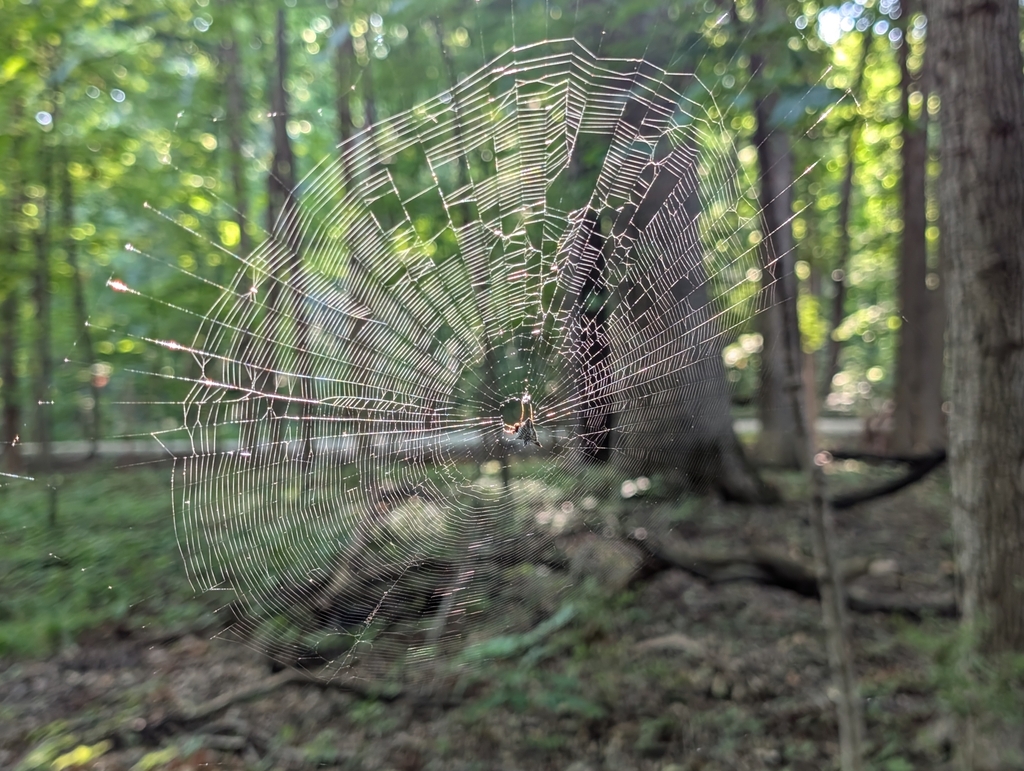
On the way out, I am about ten feet from the bridge over St. Joseph Creek when I catch the movement of a spider retreating upward along its web. Does it see me or detect the vibrations? I do not know: I remember spiders doing the same thing when I worked up in the Apostle Islands verifying vegetation maps and came crashing through the forest on my way back to the lighthouse or ranger station at the end of the day, hungry as the sun was going down. I walk around to the other side of the railing to find the spider, and as I do she walks back to the center of her web and shakes, rattling the cage as I stand there. She is a magnificent spider with black-and-white barred legs and an abdomen patterned like glazed ceramic, cream with black waves undulating lengthwise to her spinnerets. She vibrates for a few seconds before retreating back beneath the handrail. I take a few photos before walking out over the bridge crossing a colony of lanky, yellow-flowered wingstem; American pokeweed beginning to fruit; and a floodplain filled with wood nettles, all lacy with long-armed staminate inflorescences salted with white anthers.
Saint Joseph Creek is running high and brown when we arrive. I let Brooklyn off her harness and she races into the water, then crouches down to wallow up to her chin and bite at the water. It has been raining on and off much of the day. The creek is high enough to drown the stones that yesterday were trapping catalpa flowers, the grass growing high along the bank bent over and trailing downstream like wild rice or floating bur-reed. The stormwater swirls, giddy at its release from beneath the village streets, waving at us as it passes by, pirouetting around downed logs and gushing beneath the bridge, taking the corner at full speed to disappear into the canal between the road and the homes, then off to the DuPage River. I clap, and Brooklyn scrambles up the muddy slope to meet me.
She does not want to walk in the rain, which is picking up, but we walk anyway, past the sugar maple that fell off its pedestal a few years ago and now lies parallel to the trail, squeezing out dumpling-sized artist’s bracket fungi from between the ridges of bark; past a pokeweed growing fast with inflorescence white and lacy, uncoiling, floral buds small as full-size knotweed flowers; past the last flower of a great waterleaf hiding gauzy blue beside a fallen log; past narrow-leaved leek flowers opening lantern-like along the trail, lighting up the darkening woods as rain increases to the volume of lentils spilled carefully, slowly, but steadily from between the fingers, a fistful every 15 seconds or so.
A pale moth—perhaps a morbid owlet; I have seen them here several times before in early summer—flies alongside us and settles among the calf-high enchanter’s nightshade plants. I reach in to find it, and it flits up above the nightshade canopy before plunging in again to settle beneath a great waterleaf. I tap that plant as well, and the moth crosses our trail and disappears into the backyards where, on other walks in other seasons, the great horned owls have nested. Brooklyn is often uneasy here, and I wonder if the memory of owls is the cause.
The forest is darkening with late afternoon light and shade from the increasing rain. The leaves shudder at otherwise-invisible raindrops: doll’s-eyes with berries not yet ripe; Virginia creeper crawling on the forest floor; a colony of shortish Carex grisea; jumpseed. Moisture highlights the grain of a decorticated, standing dead sugar maple whose sapwood spirals counterclockwise upward to the branches that flare outward at the foundation of the canopy. Wild ginger colonies are placid and unmoving. The ferns twitch. Wood nettle and sugar maple leaves at eye level have grown glazed and glossy as tin. White jelly fungus is squeezing out along the ridges of a rotting ash tree.
The rain is increasing. The paths pool as Brooklyn and I walk back out over the bridge, but the river is no higher than it was when we arrived 30 minutes earlier.
Catalpa trees are carpeting the streets with flowers as though they were preparing for the second coming. Two-inch-wide, long-necked white flowers tumble down overnight with constellations of speckles coloring the margins of the petals, aggregating into stripes that lead down their throats to the stamen bases. Inside, the walls of the floral tube converge in the distance, pure white, recede to become a canvas for a dense freckling of stars. Galaxies of flowers fall each night and each windstorm, scatter to form white and black and yellow lawns over the lawns of grass, pile up bruised along the curbs, dam up against the rocks in St. Joseph Creek, pooling quietly, pollen staining their sides as the water runs by and Brooklyn and I stand overhead, staring in for a few minutes before we leave the creek behind and enter Maple Grove.
The high whistle of a golden-crowned kinglet moves among branches in the canopy. Bottlebrush grass, anthers gone now, stands forehead-high, radiating spikelets that are firm and rubbery but not yet ripe. Carex jamesii sprawls flat. Pale jewelweed is half its full-grown height and bears at its waist paired cotyledons, yellowing, remnants of last year. There are no flowers yet that I can see. There will soon be seeds.
The crepidotes that were fresh and cool and rubbery on the weekend are drying and curling on the rotting logs. A few Solomon’s plume are becoming variegated. Sugar maple seedling leaves are spotted with patches hollowed out by leaf miners.
Enemion fruits—false rue anemone—have almost all fallen. Their leaves have yellowed and begun to fall as well. I find one curved achene and pinch it between my fingers. It is as brittle as a porcupine grass seed in midsummer. Carex grisea grows knee-high at the base of a tree that the trail wraps around, as green as grass, almost blue. I bite a perigynium and find it two-thirds as hard inside as the Enemion achene, ripe but not quite done yet. There are chips from a decomposing log on the trail, the work of gnawing or digging or burrowing or hammering animals, along with bacteria and fungi breaking down the wood. Tiny flowers of honewort are past their prime, balanced atop turgescent capsules. An entire colony of wild ginger bears, so far as I can tell, not a single ripening flower. But I am not confident that I looked long enough.
Chatting bikers barrel down the narrow trail. A lawnmower buzzes in the adjacent back yard. Bellwort berries are bigger than chickpeas, smaller than marbles, but still not ripe. The seeds inside are white and pulpy.
Narrow-leaved wild leek scapes line the trail like lanterns about to flick on for the night, the inflorescences barely emerged from their spathes. Wild garlic bulblets ripen on the stem. Carex woodii leaves grow long and lax, slender fingers intertwined as they casually explore the ground around them. A peewee whistles in the canopy. A bunting sings from the pond. A tufted titmouse calls from the backyards at the far side of the forest, near the edge of the cardinal flower population that runs up the saturated bottom and muddy sides of the slough. Spittlebug goop is globbed up two inches long on a poison ivy stem.
I run across a second ginger colony and find fruits ripening beneath nearly every plant. The flowers are dry and brittle as old sponges. I break one open. Seeds spill out into my hand, chestnut brown and frosted with lard for the ants. Mayapple berries dangle beneath the leaves, tough as radishes. A wispy brome is coming up on the bare soil where they installed the culvert last year, maybe the year before last, maybe this year, I cannot remember. The soil is bare, and this grass is weak and spilling out but will not go far. On a second berm it grows with wood nettle.
Brooklyn and I reach the bridge again. She strains at the leash, and I unhook it. She is disbelieving for a few seconds, then sees her situation and bolts to the river, where she crouches down to chin height and bites at the water. A boy walking over the bridge asks if I am the father of his neighbor. I tell him I am not. He says I look like him and seems to want to say something else, but then he walks off. I watch him go for a few seconds. Then I turn back to the river, clap for Brooklyn, and turn to walk up slope. As I walk, I hear her pause a moment in the water, and I know she is watching me and wondering for just a second, considering her options. Then she races up the hill like mad so that, just as I am reaching the crest, she is passing around me, as though she would race on past me down the bridge. Instead, she turns and watches, a little out of breath, and waits. I put the harness on her. She shakes the water off. A chickadee calls as we walk back across the bridge to the parking lot.
Plants referenced
Acer saccharum — sugar maple
Allium burdickii — narrow-leaved wild leek
Allium canadense — wild garlic
Asarum canadense — wild ginger
Catalpa speciosa — northern catalpa
Carex grisea — gray sedge
Carex jamesii — James’ sedge
Carex woodii — pretty sedge
Cryptotaenia canadensis — honewort
Elymus hystrix or Hystrix patula — bottlebrush grass
“The best book, I wrote, would be the one that lasts your whole life. At some point, you would simply leave it behind.” – Sofia Samatar, Opacities
September 29, 2024, afternoon
The East Woods are clearing out, breezes brittling the Joe-pye weed pappuses, walnuts thudding to the ground and decomposing where they land, squirrels hustling across the trails, trying to remember where they cached acorns just a few weeks ago, faking each other out as best they can so that the ones they don’t retrieve no one else does, either. It’s a cutthroat world. Jumpseed achenes and the burlike capsules of enchanter’s nightshade have blackened on the stem. White snakeroot is past its prime, leaves inscribed by miner trails, flowers tramping toward the far edge of autumn. The gangly ray flowers of Short’s aster are cerulean-warbler blue. The branches of calico aster are buttoned up with tiny flowers and bobbing in the wind. Bees are keeping busy till winter hits. The pale jewelweed in the upland have all gone to pieces. One flower remains on single plant I pass. I pop it into my mouth as I walk by.
Calico aster (Symphyotrichum lateriflorum), Morton Arboretum East Woods, 9/29/2024
Spring peepers are squeaking just above the rush of the interstate. It takes me a minute to recognize their insistent, thick, high-pitched calls. The notes are ragged at the ends, as though the frogs were not quite warmed up. I had forgotten that they start singing again at the end of September. I don’t know why they do, but they do, as the fall warblers have nearly finished moving through and the prairie is beginning to senesce, and the forest understory is becoming sparse with the last flowers of broad-leaved goldenrod.
I had not noticed before this afternoon the black walnut gashed open along one side near the top of the hill, its wound spiraling clockwise down the trunk for about 15 feet. The tree has been excavated by rot and cleaned out by fire. The cavity, blackened on its inner surface, opens cleanly along the inner walls of the tree down to the soil’s surface. It extends upward ten feet or more. The outer bark and the rim of wood inside form a husk just thick enough to grasp in my hand, about two inches thick and platy-coal-charred. Yet the tree is growing fine: the canopy is half or two-thirds as full as the crown of an equal-sized but unmaimed tree 200 meters downslope. Both trees are shedding huge, well-formed walnuts that scatter across the forest floor, intermixing with last year’s eastern white oak seedlings, whose young leaves are hardly more lobed than the leaves of the Mexican royal oaks that inhabit the Sierra Madre Oriental of Tamaulipas, where I learned them, southward to Veracruz and Oaxaca. It’s a connection that the trees bear unconsciously, an ancient bridge to the tropics. Standing here, you’d never know there was such a link. The forest bristles with fruits and seedlings and improbable trees.
I scare a flock of starlings gathered on the road as I bike out. They cloud up to roost on the horizontals of the ComEd transmission tower. I turn around to get a closer look. I could do them no harm from this far away, even if I wanted to, but still they fly piecemeal into the trees flanking the prairie as I approach. I spend a few minutes enjoying the din that envelops us, trying to get a good look at the starlings between the branches, concentrating on their whistles and chirrups, before I realize that a handful of the birds I am looking at are not starlings at all, but cedar waxwings that have moved in from the side. I recognize now their thin “hisssss”’s etched over the starling chatter. They follow each other along the edge of the woods, and I follow outward along the road. Grasshoppers buzz in the reeds behind us.
A mourning cloak flits in and out along a path parallel to mine as I ride. A palm warbler darts into a buckthorn, then back out to the road behind me, where it tail-pumps and hops along the edge before disappearing again into the thicket.
Fallen branch of northern red oak (Quercus rubra) with pistillate flowers and lateral buds. Morton Arboretum East Woods, 9/29/2024
September 16, 2024; Maple Grove, 5 p.m.
The jewelweed is draped with climbing false buckwheat in fruit, achenes pulpy, wings rubbery. The vines pile on top of the jewelweed, crawling over it with no regard for its interests, twining skyward. Why shouldn’t they? The jewelweed itself is unconcerned, has basically done its job and is juicing the last days of summer, pumping the residue of the year into a few extra capsules. This is what it does. Fail to set seed as an annual, which jewelweed is, and you cease to be anything at all. It is a miracle that annuals make it across the finish line year after year. Surely one year they will fail en masse, drop off one by one as we approach winter, neglect to produce seed all along the way until an early frost takes the last plant. So we might go from having jewelweed one summer, stumbling over itself into winter, and then never again. But no. The ashes are going down, the American chestnut is all but decimated, the mighty Normapolles, those mysterious trees nestled among the birches and walnuts that blanketed eastern North America and Europe through the late Cretaceous and Eocene are now beds of fossilized pollen grains and a bucketful of flowers. Yet the jewelweed return every April, dime-sized cotyledons quivering in the ditches.
A cicada pulses from the trees along the creek. A chipmunk crosses the bridge from north to south. What sounds to me like a screech owl trills from over behind the houses at the west edge of the preserve, two short, descending songs, warming its voice up for more sustained late-night singing. The sugar maple bole that fell off its base several years ago, twelve or fifteen feet up, and now lies at the entryway to the woods has sprouted a bear’s head tooth fungus that looks like a cauliflower; rows of turkeytail fungus; a cluster of fleshy, fresh oyster mushrooms swarming with gnats; artist’s bracket fungi swelling and thickening along the side; an open-faced toothed polypore that runs brushy across the top of the fallen bole. A palmful of what appears to be mouse-scat sized sawdust pellets has collected on a shard of xylem pried from the side of the trunk as it fell.
Broad-leaved goldenrod and short’s aster are in flower. More cicadas are calling, the final shouts for the evening from the hardiest of the population, the latest callers, the night owls who will overlap with the evening crickets and the katydids down the road. I shake hands with the sandpapery leaves of a slippery elm, watch two squirrels spiral down a sugar maple in full chase, bounding across the forest floor, then racing up another tree again as I get closer. Wild leek has mostly shed its seeds, though a few still lodge jet black in their papery holsters. Maple leaves are pierced with insect holes. Wood nettle is dusty along the trail’s edge.
On the ride home, I climb the hill north of the new police department. The sun glows behind me, the moon rises ahead, two days from full, obscured by the clouds, over the wreckage of the municipal buildings. They are being demolished to make way for something new, I suppose. Below them, St. Joseph creek trickles beneath the railroad tracks and is swallowed by the earth, travels underground for more than half a mile before it emerges again on the other side of Carpenter Street. The memory of that dark trip is the water’s alone.
I write this as though it were happening eternally, in the forever-present tense, but September 15th was last night. What about the actual now? Mittens is kneading the blanket at my feet. Crickets bleat and click and whistle through the screens. The moon rises, then is risen. We wait for our son to come home. I have a pile of books beside me that I cannot hope to get through, and I feel a distracted month coming on. I read these words from George Orwell:
So long as I remain alive and well I shall continue to feel strongly about prose style, to love the surface of the earth, and to take a pleasure in solid objects and scraps of useless information. It is no use trying to suppress that side of myself.
But then I have already read them, and mittens is curled and sleeping. The moon, I imagine, is high over neighbor’s house, but I have not yet gotten up to see for sure. Brooklyn is resting her chin on the windowsill, listening to the crickets.
September 8, 2024: lunchtime, Lyman Woods
There was a grass spider by my feet, but I had no idea it was there until it raced from the narrow plain of its web down into its funnel, where it disappeared into the dark. That flick of light at the periphery of my vision—the trace of something live disappearing—where Brooklyn’s paw would have been if she were with me and if she were the kind of dog inclined to walk alongside, is what made the spider apparent. Had it stayed still, I would not have noticed it at all.
Short’s aster and elm-leaf goldenrod were in bloom. Calico aster stems were dotted with white-tipped buds. Inflorescences of stout wood reed were pendulous throughout the forest: in the wet soils alongside the buttonbush swamp rimmed with swamp white oaks, in the eastern white oak uplands, along the trails all the way down the slope, where the shade is deepest between the trails. Joe-pye weed achenes gone gray were still adhering to the plants. Crickets were humming and purring. Cars were racing up and down Highland Avenue on a Sunday afternoon, a third of a mile west of the spider who was hiding, momentarily.
She reappeared abruptly in the shadow of the funnel. I could not tell if she sensed that I was there. I was out of her direct light, but the shirt I wore was yellow and likely cast an odd-colored reflection. She moved hesitantly, came just to the event horizon, then raised her front legs at me as though in defense, like a boxer. Perhaps she was only waiting for prey. Like she understood that something was there and, not knowing what kind of threat or opportunity I might pose, was set to strike, fight back, or retreat. I leaned in a few inches. She twitched and was gone again.
A grass spider’s web is, I read later, not sticky at all. The spider compensates by dashing after her prey when it bounces off the web. How fast? I don’t know. I read that grass spiders are “very fast,” like “lightning,” but I don’t find an actual velocity. Someone must have figured this out. She appeared again, no more warily than at her first entrance. She seemed fearless, up to tangling with whatever, if she needed to. There is nothing too big out there for me, she seemed to think. I will catch it and I will stun it and I will eat it at my leisure. For a grass spider, there is no thought of a squashing foot or a swat from a magazine.
August 31, 2024
The St Joseph Creek bottomland at Maple Grove is still flooded with pale jewelweed flowers and fruits in a variety of stages: outcrossing flowers with petals spread wide; cleistogamous flowers closed tight; capsules slender and barely formed; others turgid, exploding at a brush. Bumble bees were foraging in the jewelweed canopy this evening. A few bees barely dipped their heads into the doorways of the open flowers before flying off, presumably because many flowers were already emptied of nectar. Most bees, however, landed on the floors of the corollas and slid inside like fingertips into thimbles. They brushed the floral ceilings with their backs on the way in, potentially releasing or depositing pollen, then they disappeared inside. For a second, only the tips of their hairy abdomens were visible as their probscises unrolled and dipped into the short nectary at the base of each flower. They collected what nectar they could, then they were off to the next.
Of this amble among the jewelweed flowers, Gerry Wilhelm and Laura Rericha write, “medium to large bees… lean into a corolla to glean nectar from the thick-walled nectar spur, and while doing so trip the anther ring, which causes pollen to fall down and coat the head and anterior thoracic region of the bee… Eventually the anther ring falls away and the once-concealed stigma becomes viscid and receptive… Flowering periodicity promotes pollination within a population, in that there are flowers of different ages that correspond to either the male or female phase of anthesis… Pollination is inevitable.” I see the flowering periodicity and how it helps the population along, but I’m afraid I don’t see how inevitable pollination is. If the system worked that perfectly, I suspect the species would dispense with the closed, cleistogamous flowers, which make the most sense as a fail-safe for plants that do not successfully get pollinated, or at least not often (more on this in my recent post on late-season jewelweed).
Smaller, slenderer bees were working the flowers as well, shining in the evening light. These slighter bees crept up the inner walls of the corollas rather than landing on the base and coming in upright. They were too small to scrape along the inner surface of the flowers, and thus they could not have made contact with the stigma. Likely they were swiping nectar or pollen. Laura and Jerry list a few bee species that take advantage in this way; from their short list, I have previously seen the pure green sweat bee at Maple Grove. I noticed about half as many small bees as bumble bees this evening, whether because they are less common or just less evident I don’t know.
Climbing false buckwheat is transitioning from flowering and fruiting, looping among the jewelweed leaves alongside the handrail on the south side of the bridge. On the west side of St. Joseph Creek, down the footpath that leads north between beds of white bear sedge etched with Cerodontha trails, a log that grew thick with stump puffballs this summer is frosted with honeycomb coral slime mold and capped with a colony of orange mycena that, as always, looks as bright as a bagful of candy (though this is not thought to be a tasty mushroom, and readers are advised not to try eating it).
I follow the trail over slopes clothed with dilapidated black snakeroot, wild ginger, and net-leaved, insect-eaten wood nettle. I pass a log I have been watching decompose for several years and find it flatter than it was last August. It is declining gracefully and still has years left to give back to the insects and fungi. I leave the trail, walk down through the woods, and encounter a lawn of Wood’s sedge, Carex woodii, about 20 feet in diameter. I visited this very patch on my birthday in 2019 but had forgotten about it. It looks exactly as it did 5 years ago, a picnic-sized blanket of soft green in the forest, each plant burgundy-based. This species is a CBG Plant of Concern, listed as rare in the state, but it is very happy in the few sites where I know it from Maple Grove and The Morton Arboretum (and apparently Lyman Woods, based on collections made in 1978 and 1979, and where the species played a role in the preservation of the forest, though I haven’t seen it there myself that I recall). It is locally abundant, but perhaps not all that common across our landscape.
I walk downslope another 30 feet, toward the slough that fills from the culvert beneath the trail before it runs in a ditch down toward the ephemeral Echinochloa wetland in the middle of the forest. The soil flanking the ditch is saturated and thick with poison ivy. Taperleaf waterhorehound is flowering along with arrow-leaved tearthumb. I am wearing shorts, so I move cautiously. Great blue lobelia is flowering in abundance. In the muck nearby, a couple of cardinal flowers are blooming. These two species have divvied up their portions of the bottomland: Lobelia siphilitica, the blue one, in the wet meadows alongside the trails and up where the soil is spongy; L. cardinalis, with brilliant red flowers, in the mud, sometimes right on the banks of the flowing water.
Upslope, a shaft of sunlight illuminates an orb-weaver’s web slung between a sugar maple sapling about as big around as my thumb and a neighboring maple tree about eight feet away. Struts run diagonally between the two trees, a broad span through which a coyote or deer or squirrel might run without thinking, or a botanist. Some of the capture spiral threads are torn, altogether missing or drooping against a neighboring strand. Some radii may need to be replaced. But somehow the web has made it through the day intact enough to catch the sun streaming in, and the spider is waiting in the middle.
I move slowly, snapping photos as I approach. I can see now that she is a spined orb-weaver, Micrathena gracilis, a common spider but one I have only seen a couple of times before. Her abdomen is armed with thorns. When I am about three feet away, she dashes off to the upper frame of her web, from there up along one of the uppermost moorings to a branch running in from the nearby maple. She rests there until I leave.
Over the weekend, I will read that the spider I’ve seen likely rebuilt her spiral later in the evening, perhaps as Rachel and Louis and I were eating supper. I will read that she is in the right habitat: a spiny orb-weaver displaced to a conifer forest will disperse to a deciduous forest if she has half a chance, probably for reasons of the light environment. For if she is in the open, receiving too much light, the spider has to spend a greater portion of her day in the shade to avoid overheating, and this is a lost opportunity to feed. If she is compelled to make her web in the open, the spider will build her web facing the east and west, like a compass plant that avoids overheating by turning its edge toward the high noontime sun. Conversely, in the shadier forest, the spider will face her web toward the north and south. This is what the articles say, but my photo suggests this web was roughly facing the setting sun, westward in the shady forest. I will read that her spines may be a defense against predators, but that no one knows for sure.
And as I read, I will be reminded of Dylan Thomas’s litany of “useful” Christmas presents in A Child’s Christmas in Wales, closing with the “pictureless books in which small boys, though warned with quotations not to, would skate on Farmer Giles’s pond and did and drowned; and books that told me everything about the wasp, except why.” It is always like this: one person’s “why” devolves into a “how” or “what” in the next person’s hands. The spines are there, perhaps, because they defend the spider. That sounds like an answer to the question, “why?” But then the response: “So perhaps Micrathena defend themselves with spines… but why should they? Many other spiders don’t. Why not find a simpler way?”
There will never be an end to whys. Yet as I unlock my bike from the signpost buried at the edge of the floodplain, and as the cicadas wind down for the evening and the sun cants between the maples, I inhabit a universe of whats and whos. Bees patrol the flowers, pollinating or stealing as they see fit. Spiders perch in the middle of their webs, oriented whichever way strikes their fancy. Lobelias set up shop in wet forest and give each other as much room as they need. These are the things that I go out to find at 5 p.m. on a Saturday night and that I live among when I arrive home.
Plants referenced
Acer saccharum — sugar maple
Asarum canadense — wild ginger
Carex albursina — white bear sedge
Carex woodii — Wood’s sedge
Fallopia scandens — climbing false buckwheat
Impatiens capensis — pale jewelweed
Laportea canadensis — wood nettle
Lobelia cardinalis — cardinal flower
Lobelia siphilitica — great blue lobelia
Lycopus rubellus — taperleaf waterhorehound
Persicaria sagittata — arrow-leaf tearthumb
Sanicula sp. — black snakeroot
Toxicodendron radicans — poison ivy
Sources
Biere JM, Uetz GW. 1981. Web Orientation in the Spider Micrathena gracilis (Araneae: Araneidae). Ecology 62: 336–344.
Bukowski TC, Christenson TE. 1997. Natural History and Copulatory Behavior of the Spiny Orbweaving Spider Micrathena gracilis (Araneae, Araneidae). The Journal of Arachnology 25: 307–320.
Hodge MA. 1987a. Factors Influencing Web Site Residence Time of the Orb Weaving Spider, Micrathena gracilis. Psyche: A Journal of Entomology 94: 068503.
Hodge M. 1987b. Macrohabitat Selection by the Orb Weaving Spider, Micrathena gracilis. Psyche 94.
Magalhaes I, Santos A. 2012. Phylogenetic analysis of Micrathena and Chaetacis spiders (Araneae: Araneidae) reveals multiple origins of extreme sexual size dimorphism and long abdominal spines. Zoological Journal of the Linnean Society 166.
Thomas D. 1969 [originally published 1954]. A Child’s Christmas in Wales. New Directions Publishing.
Wilhelm G, Rericha L. 2017. Flora of the Chicago Region: A Floristic and Ecological Synthesis. Indiana Academy of Science.
27 August 2024
Rachel and I are sitting by the fire ring in the backyard, watching the clouds unfold above us. They come in slowly, a blanket of gray that frames erupting mounds of water droplets and ice crystals, smoldering in the setting sun, the color and intensity of glowing embers. Beyond that, a cloud churns, starkly white, growing from within as air currents cycle within, the heat of the day rising and driving some engine of cloud-making like we have never seen before. The optics elude me: how is one cloud illuminated white, while the other burns yellow? Perhaps the setting sun casts light through one cloud, reflects against another, is shaded by a third. Everything is in motion, three cloud layers against the evening sky, like a juggler’s trick.
I watch a single lobe of the white cloud, the smallest one I can see, a pimple extruded into a swelling tumor. How big is this thing a mile above my head, potentially growing to miles in thickness? How big is the smallest plume I can discern? Ten feet in diameter? 100? Behind the clouds, the sky is Arctic blue. This is what atmosphere looks like on Earth at its best, our blessed cocktail of nitrogen and oxygen, carbon dioxide and argon, water vapor that has not yet coalesced into clouds, plus the lesser gases and particulates that settle in the crevices of the leaves and our lungs, that feed or clog, enable or hamper life, warm the earth.
The wind picks at the placket of my shirt and slips inside. After a stifling day—I stepped outside this afternoon, and my glasses immediately fogged up—the wind feels wonderful. Lightning fires off to the south; in 15 seconds the thunder reaches me. A cicada lands in the plum tree and squeals in pulses for a minute. His call tails off, then he tears out of the tree only to collide with the garage. I look over just in time to watch him bounce off and fly away. Do cicadas remember such moments?
Rachel’s sunflowers have grown to the tops of the windows. The pear tree I topped a decade ago is heavy with fruit. Some has fallen to the ground where it is perforated by wasps or ground down by squirrels. Most is still hanging on the tree.
I reread a few lines from the Epic of Gilgamesh. These lines, from what we today call a prologue—what would this have been called in Akkadian?—were added as an opener to the book 500 years after the Babylonian version was written down, then translated 3200 years later by Stephen Mitchell:
Climb the stone staircase, more ancient than the mind can imagine,
approach the Eanna Temple, sacred to Ishtar,
a temple that no king has equaled in size or beauty,
walk on the wall of Uruk.
…
Find the cornerstone and under it the copper box
that is marked with his name. Unlock it. Open the lid.
Take out the tablet of lapis lazuli. Read
how Gilgamesh suffered all and accomplished all.
The sun is down and the clouds are all gray now, the lightning crackling in all directions. I head inside. We open the windows, let the descending atmosphere clear out the house. I write for a bit, and then the rain starts.