Late August: Just passing through

“The house represents what we ourselves would like to be on earth: permanent, rooted, here for eternity. But a camp represents the true reality of things: we’re just passing through.” — Roger Deakin, Wildwood (pp. 14-15)

24 August 2024
We have passed midsummer in the forest. Ride out through the Arboretum’s East Woods this week, and you’ll find woodland sunflower in full bloom. Walk the Maple Grove Forest Preserve trails, and you’ll pass sloughs of great blue lobelia, flowers raised to shoulder-level. Joe-pye weed has already passed full bloom, its spindly-armed flowers intermixed with tufts of achenes. Elm-leaf goldenrod began flowering just this week. Drummond’s aster flowers will open soon.

But on most walks through the forest this week—through almost all of summer—I think of Edgar Anderson’s “green lull,” his term for the midsummer forest, after the spring wildflowers have senesced and the canopy has closed, but the fall flowers are not in bloom. Most trails are still a wash of green right now, pricked with white or colored flowers. On my bike ride into work on Tuesday, I stopped in the East Woods to find all the seeds shed from white grass along the right side of the trail that leads north from Parking Lot 10, the pale jewelweed flowers and fruit abscised and flowering stalks mostly dropped on the left side. White snakeroot leaves were etched with leaf miner trails; a few were in full flower. Enchanter’s nightshade fruits were brown. White avens seed-heads crumbled easily between the fingertips into nickel-sized palmfuls of slender, obovate achenes with long-slender tips. Early meadow-rue was yellowing. This time last year, the trail was littered with eastern white oak seeds germinating, the fruit of a mast year strewn over the forest floor by squirrels who would take a bite here and there and toss the rest to the side. This year, the trails are littered with red oak acorn shells.

Northern red oak (Quercus rubra) acorn shell on a fallen log. Lyman Woods, 24 Aug 2024.

This morning’s walk into Lyman Woods from the hospital parking lot is sticky-warm. The woods are buzzing with cicadas, humming with crickets. Eastern wood pewee whistles hang in the humid air. Jumpseed spikes are mostly lined with white fruits about ready to spring off into the trail edge, but there are a few young flowers at the bases of many of the inflorescence stalks. Woodland tick-trefoil seeds have mostly fallen, but several stalks bear a few depauperate purple flowers. Honewort schizocarps are rounded at the bases, arched outward in the middle, narrowed to pencil-sharp tips, plump, rigid, almost brittle. White vervain flowers have crept slowly upward along the spikes nearly to the tip. The leaves of one vervain plant are cloaked in powdery mildew. Flowering hog-peanut winds around the stalks of goldenrods and grasses. The wood nettles are draped with flowers lacier than doilies, lacier than even Queen Anne’s lace, implausibly delicate for a plant that inflicts a painful sting when it is only weeks old and becomes stout and heavily armed by early summer. I might have expected the greens of oak catkins for a plant like this, not a profusion of tiny white flowers sized perfectly for a ladybug’s bouquet. The leaves of a bitternut hickory are pimpled in aphid galls.

Honewort (Cryptotaenia canadensis) schizocarps–the hardened fruits–ripe and ready to disperse. Lyman Woods, 24 August 2024.

There is a new-fallen northern red oak branch across the trail on the loop I like to take through the forest’s southern end. It fell some time after the leaves were full-size. It is roughly two feet in diameter, a massive limb to have cleaved off the side of a tree. The sapwood at the tip is sprawled out into slivers that became frozen in place by the trauma of breaking, arched as though the branch were photographed in mid-fall, before the xylem could snap back into position. Wedged between two shards of bundled vessels is a red oak acorn that has been decapped, shucked, and nibbled cleanly from the base to just a third of the way up the acorn. The seedling at the tip—just the germinal root and shoot—is untouched and might survive if the seedling hasn’t already dried out too much to grow. I pull the acorn out from between the broken margins of the branch. It feels very light, so perhaps the seedling is dead already. I toss it to the ground to give it a chance. Scattered across the log are scores of red oak acorn shells, etched with the markings of squirrel teeth and claws.

The forest opens up at the base of the hill to a wetland that grows thick with willowherb and common jewelweed. A buck snorts off to my left, toward the houses. As I hike out, I pass a black cherry tree about six inches in diameter that has cracked open and fallen across the trail. It is thoroughly excavated with galleries, capacious enough for tens or hundreds of thousands of I-know-not what. Beetles? Ants? Maybe. Whatever its denizens, however, the black cherry leaves me wondering how many hundreds or thousands of homes this tree has served as after its death. How many more insects will it host before it rots away? For how many decades will this fallen black cherry continue returning carbon, nutrients, and sustenance to the forest?

Plants referenced

  • Ageratina altissima — white snakeroot
  • Carya cordiformis — bitternut hickory
  • Circaea canadensis — enchanter’s nightshade
  • Cryptotaenia canadensis — honewort
  • Desmodium glutinosum — woodland tick-trefoil
  • Eutrochium purpureum — joe-pye weed. Three Eutrochium species are fairly common in the area, but this is the one encountered most frequently
  • Geum canadense — white avens
  • Helianthus sp. — woodland sunflower (here I am including H. strumosus and H. divaricatus, both of which I run into in the East Woods)
  • Impatiens capensis — common jewelweed
  • Impatiens pallida — pale jewelweed
  • Laportea canadensis — wood nettle
  • Leersia virginica — white grass
  • Persicaria virginiana — jumpseed
  • Prunus serotina — black cherry
  • Quercus alba — eastern white oak
  • Quercus rubra — northern red oak
  • Solidago ulmifolia — elm-leaf goldenrod
  • Thalictrum diocium — early meadow-rue
  • Verbena urticifolia — white vervain

Late-summer jewelweed

17 August 2024
Pale jewelweed is mounded high in the floodplain of St. Joseph Creek. Its undulating surface forms a landscape that does not parallel the ground, but instead creates a smoother surface hovering above. With their roots in the soil, the jewelweed plants grow in proportion to the intensity of light streaking in between the trees: stronger light, taller jewelweed.[1] Thus the surface of the jewelweed integrates over the deep history of earth, which laid down the bedrock over the course of billions of years; the glacial history that shaped the landforms over the past 2.6 million years; the last 15,000 years of floods, erosion, and soil formation that put the final touches on the land we see today; and the light environment shaped by the vagaries of competition, disease, windthrow, frosts and droughts, pollination and germination every year and every day. These processes together form the land and the forest that clothes it. Jewelweed responds to this entire history.

Jewelweed (Impatiens pallida), outcrossing flower. Maple Grove, 17 Aug 2024

Step carefully between the stalks, and the jewelweed canopy closes around you. The stems are as big around as my pinky, the joints tough and thickened like gouty knuckles. The light cascades pale green through the leaves above. The air is moist and still, like being inside an organism. Hidden within this dimly lit room is the decomposing bole of a severed red oak, shingled over with turkey tail fungus, peppered with tiny fungal caps. The jewelweed forest reminds me of the densely-planted, narrow-trunked oak forest in the southwest corner of the UW Madison Arboretum’s Grady Tract, planted by a caretaker in, I believe, the 1940s. The trees there have grown up dense and suppressed, and little grows beneath them (so far as I remember; I was last in that forest well over a decade ago). The understory beneath the jewelweed is about as sparse: a goldenrod, a spindly honewort in fruit, and a few wood nettles grow here, little else.

Where Brooklyn and I enter from the Gilbert Park parking lot this morning, Maple Grove is framed by an orb-weaver suspended between young sugar maples. Opened, outcrossing flowers whose spurs still hold a drizzle of nectar are strewn across the jewelweed landscape. They rub shoulders with lima-bean sized cleistogamous flowers, which are clamped shut, closed to pollen from the outside world, obligate self-pollinators. Cleistogamous flowers are a failsafe, a way of ensuring that seeds get into the next generation if pollination is poor, but at a cost: self-pollinated flowers give rise to seeds that germinate less reliably, and seedlings that die more quickly and grow more slowly, on average, than the out-crossed seeds.[2] The flowers are interspersed with turgid capsules; with a light squeeze at the base, the fruit walls recoil explosively, spitting seeds across the trail. The jewelweed canopy is pierced with wood nettle inflorescences. Along its edge are flowering white snakeroot and the dregs of tall bellflower.

Brooklyn and I cross the footbridge over St. Joseph Creek, stepping up and over as the floodplain floor slopes downward beneath us, until the bridge railing comes almost equal to the upper margin of the jewelweed. Bringing my eyes down to the level of the railing, I feel like a canopy explorer, like Nalini Nadkarni or Meg Lowman may have felt their first times up in the tree canopy—what one might call the “real canopy,” though this one is real as well, buzzing with bees and speckled with raindrops. Wingstem and cutleaf coneflower are blooming, superficially similar in appearance today, with straplike, spidery, twisted petals slightly pinched at the tips. South of the bridge, giant ragweed towers over the jewelweed plants, roughly twice their height. An evening primrose stands six feet tall on the riverbank. Along the edge of the bridge grows what I take to be horseweed, downy with seeds. The river is turbid and a bit high from last night’s rain. Brooklyn will not pass until I let her get into the water. She drags me partway into the water. White bear sedge leaves are frayed by the summer, but they still have months of work ahead before they retire. Most will make it all the way through the winter to get the plant to next year’s young leaves.

Wingstem (Verbesina alternifolia) in floodplain of St. Joseph Creek, Maple Grove FP, 17 Aug 2024

Brooklyn jumps onto the great sugar maple bole that fell across the trail a couple of years ago. I crawl over it gracelessly. There are still 17-year cicada holes punched into the muddy trail. Jumpseed spikes studded with brittle white seeds line the trails. We climb the slope behind the houses on the east edge of the preserve. A jogger runs through on the main trail down to our left, pushing a stroller and playing music loudly. The jogger’s music fades off to the south, only to be replaced by hammers at work on the houses to our right. They punctuate the sustained purr of the crickets.

Great blue lobelia is flowering in the low areas along the trail. A stand of bottlebrush grass pooled at the base of the hill has dropped a quarter of its seeds, and the rest release easily at a touch. Pokeweed flowers are turning gradually into hard fruits. False nettle is stout with inflorescences. Late boneset is in full flower. Elm-leaf goldenrod flowers are in bud. Mayapples have almost completely given up: most are pale, many are stooped, some are kneeling already beneath the still-growing trees, surrounded by the red oak acorns that were pollinated last year, fertilized and developed this year, and that will germinate next spring. Early-falling leaves and plants are bedding into the litter that will nourish and insulate the roots and rhizomes of the understory through to next year.

The narrow-leaved wild leek seeds have almost all dropped. A few are still nestled into their capsules, valves flexed open, the seed coat black and glossy as a marble. On most plants, even the residue of the flowers is gone, leaving only the pedicels. The broad-leaved wild leek seeds are still ripening, however. I squeeze the green capsules that surround them and feel the seed coat give way, the pulp inside squeezing out. Scratch away the fruit wall, and you find the seed glistening inside, hardening up. A few seeds have been devoured by insects. On one plant, I find a hole drilled through the capsule and the seed inside gone. Another capsule has been chewed open from the top, and half of the seed coat persists like the remnant of a soft-boiled egg in an egg-cup, the insides eaten out, the lower half of the shell seated comfortably and untouched in the base of the capsule. It is as light as chaff.

A red-eyed vireo and an eastern wood pewee are calling as Brooklyn and I walk out. A pleated pluteus is growing from a rotted log by the parking lot. Crickets are still purring. Solomon’s plume is yellowing, bedraggled. Black snakeroot fruits are barely hanging on to the last days of summer.

Pleated pluteus (Pluteus longistriatus) growing on a decomposing log
near the Gilbert Park parking lot, Maple Grove Forest Preserve, 17 Aug 2024

Plants referenced

  • Ageratina altissima — white snakeroot
  • Allium burdickii — narrow-leaved wild leek
  • Allium tricoccum — broad-leaved wild leek
  • Boehmeria cylindrica — false nettle
  • Campanulastrum americanum — tall bellflower
  • Carex albursina — white bear sedge
  • Cryptotaenia canadensis — honewort
  • Erigeron canadensis — horseweed
  • Eupatorium serotinum — late boneset
  • Impatiens pallida — pale jewelweed
  • Laportea canadensis — wood nettle
  • Lobelia siphilitica — great blue lobelia
  • Maianthemum racemosum — Solomon’s plume
  • Persicaria virginiana — jumpseed
  • Phytolacca americana — pokeweed
  • Podophyllum peltatum — mayapple
  • Quercus rubra — red oak
  • Rudbeckia laciniata — cutleaf coneflower
  • Sanicula sp. — black snakeroot; I have never been confident about which species I am looking at, so I’ll leave these at Sanicula for the time being
  • Solidago ulmifolia — elm-leaf goldenrod
  • Solidago sp. — goldenrod (not identified to species)
  • Verbesina alternifolia — wingstem

References cited

[1] John Curtis wrote about this phenomenon in 1959; see my previous post, “Stumbling into the universe by chance,” for the quote and citation.
[2] Waller DM. 1984. Differences in Fitness Between Seedlings Derived from Cleistogamous and Chasmogamous Flowers in Impatiens capensis. Evolution 38: 427–440.

Early July: wild leeks, morning cardinals

Rachel and I awaken early on the first of July after a week away to find that the robins are not the ones singing at 3:30 any longer. Cardinals have taken over. The birds pass this baton every summer, but I rarely notice until it is over. The natural year pivots on changes like this.

Brooklyn and I walk through the neighborhood at about 5:45. A rabbit leaves the lawn on Washington Street to devour smartweeds in the sidewalk cracks. Brooklyn is uncharacteristically restrained. We walk on to Maple Grove, where narrow-leaved wild leek fruits are developing, pale and pulpy inside the skin. The leaves are several weeks past. White avens fruits are soft but becoming hooked at the tips. Agrimony burs are rubbery. Enchanter’s nightshade fruits are becoming bristly but far from ready to disperse, still tipped with flowers. A mourning dove calls. Robins and cardinals share the stage here, singing over the barking red-bellied woodpeckers.

Allium burdickii, seeds developing. 1 July 2024, Maple Grove

White avens fruits are hardening. Carex cephalophora is sprawling, shedding perigynia. The white ash seedlings, doomed to begin with, are further insulted by ash bead gall mites, who have left the leaves covered in pustules. Fowl manna grass spikelets clatter to the ground like scattered couscous as I strain the inflorescences between my fingers. Last fall’s eastern white oak seedlings line the trail, still thick where the mast has let them fall.

A great-crested flycatcher calls. A tufted titmouse responds. A white slime mold has pasted together the leaves of an Amur honeysuckle. A deer feeding in a backyard stands to look at Brooklyn and I head-on, and Brooklyn is dumbfounded. The deer’s antlers are beautifully felted but still blunt-tipped. It watches us for several minutes, scratches its head with its right rear leg, moves on. A red-eyed vireo calls, “Where am I?” “Here I am.” “Where are you?” “There you are,” over and over. A peewee whistles. American pokeweed is coming into bloom.

Floral buds on the broad-leaved wild leeks are tipped white on radiating peduncles, fireworks-in-training. The scapes are red, most of them canted diagonally. There are great colonies of them in the understory now, while their narrow-leaved cousins are spread out along the trail edges. If you had any doubts that these two—Allium tricoccum and A. burdickii—were separate species, this is the time to look. Leaves gone, the stems alone give them away (red and leaning, arching beneath the inflorescence, for broad-leaved wild leek; straight, green, and relatively short for narrow-leaved wild leek). But the flowers clinch it. Scan the forest floor, and the broad-leaved species jump out at you right now, while the narrow-leaved wild leeks fade into the litter. They can’t very well be a single species: the one could never pollinate the other, as the narrow-leaved species goes to seed before the broad-leaved species even flowers.

Allium tricoccum in full flower, 7 July 2024, Maple Grove

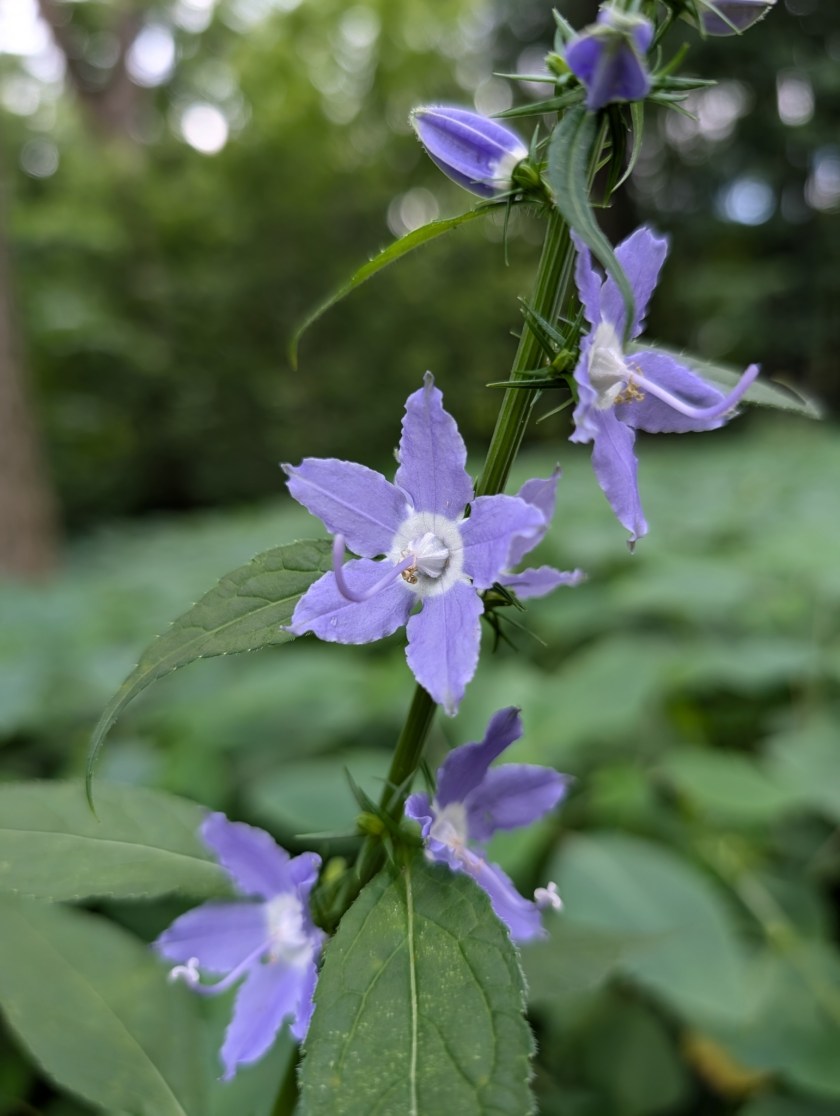
On the walk out, American bellflower is blooming in the St. Joseph Creek floodplain, alongside the wood nettles that are sparsely pimpled with midge galls. White bear sedge leaves are etched with Cerodontha tracks that run lengthwise and then diagonally to interconnect.

That night, fireflies streak through the hydrangeas and asters outside our front window. Cicadas call. The annual cicadas have picked up as they do this time every year. In a few weeks, the cicadas will give way to evening crickets just as the robins have passed the baton to the cardinals.

American bellflower, 4 July 2024, Maple Grove

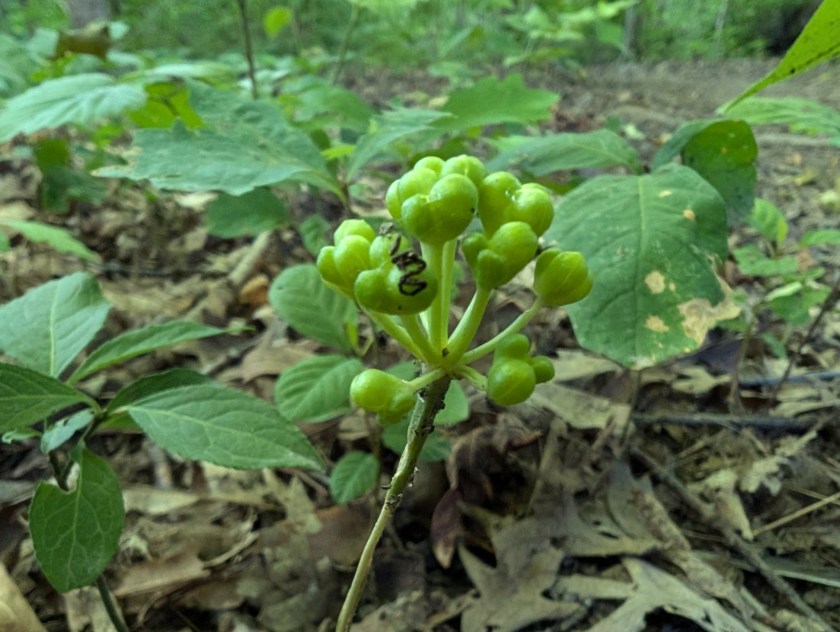
The morning of the 7th, I return to find wingstem about to come into flower, doll’s eyes fruits developing, an ash seedling tipped with a gall. Another giant ash tree has fallen, and the bark sloughing off reveals a reticulum of Armillaria rhizomorphs. The forest floor is strewn with the fallen tips of sugar maple branches withered off by the summer’s 17-year cicadas. White vervain is flowering. The first flowers of broad-leaved wild leek are fully open. Scanning the forest floor as I walk through, I am struck at the size and abundance of the colonies. This year may turn out to be the best show of Allium tricoccum that I’ve ever seen in Maple Grove.

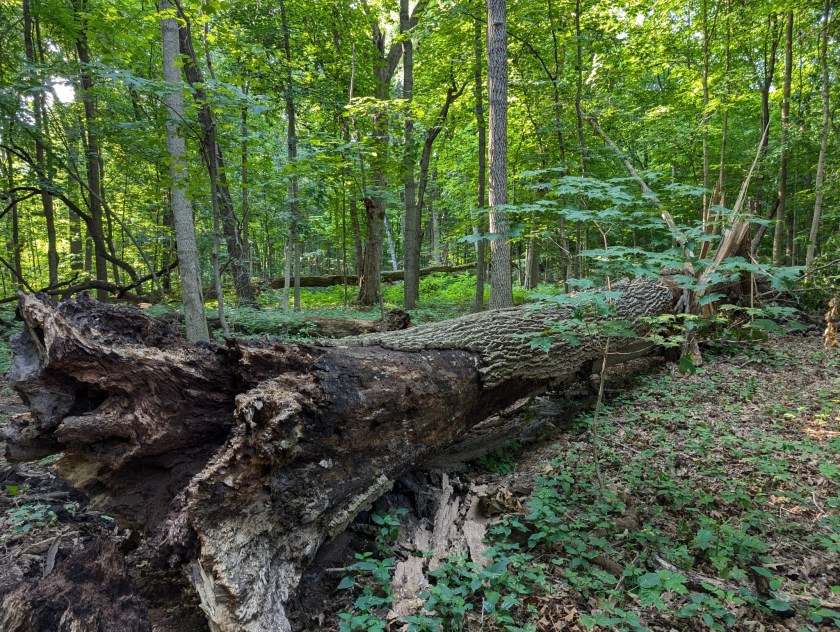
Fallen ash, 7 July 2024, Maple Grove

Plants referenced

  • Acer saccharum — sugar maple
  • Actaea pachypoda — doll’s eyes, white baneberry
  • Agrimonia gryposepala — common agrimony
  • Allium burdickii — narrow-leaved wild leek
  • Allium tricoccum — broad-leaved wild leek
  • Campanulastrum americanum — American bellflower, tall bellflower
  • Carex albursina — white bear sedge
  • Carex cephalophora
  • Circaea canadensis — enchanter’s nightshade
  • Fraxinus americana — white ash
  • Fraxinus sp. — ash. Everything I have run into in Maple Grove appears to be white ash, F. americana, but I’m not certain enough to say with fallen trees.
  • Geum canadense — white avens
  • Glyceria striata — fowl manna grass
  • Laportea canadensis — wood nettles; note that the midge gall photo linked in this post is from the same population, but taken in 2020
  • Lonicera maackii — Amur honeysuckle
  • Phytolacca americana — American pokeweed
  • Polygonum arenastrum / P. aviculare — sidewalk crack smartweed. These two species are treated as synonyms in Flora of North America, but separate species in Rericha and Wilhelm. I could not key this individual confidently to one over the other.
  • Quercus alba — eastern white oak
  • Verbesina alternifolia — wingstem

June 4: Cicadas

The European beech outside the window of our herbarium is laced with cicadas. We watch them from inside at eye-level, near the middle of the canopy. They swerve between the branches, navigating as though blindfolded, following the calls of potential mates, looping between the branches and bumping into leaves on their way to find one another. They can see with those great red eyes, but they hardly need them. Cicadas could drift through the world on sound alone.

Yesterday afternoon, my colleague, a forest ecologist and dendrochronologist, was explaining to a group of collaborators from China how our wood collection notates not just the passing of time, but the landmarks by which we recognize its passing. Fires, droughts, years of heavy rain, early freezes, lawnmowers scraping against the bark, a fungal infection, the tree’s response to that infection: all are marked in the trunks. As she spoke, the cicadas outside buzzed so loudly that I suspected the windows were open. (They were not.) In a few years, new oak samples in our collection will show the impact of the 2024 cicada emergence as a slight decrease in growth, on average, for this year and perhaps a few more.

This morning, the cicadas start calling at 3:07, the low hum of the first species I hear each morning. This is the species that drones like an electric guitar resonating through a distortion pedal, or a Tuvan throat singer. The sound rises for two minutes. Our smaller cat, Joni, is vigilant. The droning cicadas are accompanied by the chirrups and buzzes of one of the other species, then they all slowly quiet. I had until today thought they started up somewhere closer to 9:00.

By 3:11, the sound has died down to nothing. Perhaps one of the cicadas awoke in the night to a bad dream, aroused the others as it rolled over on the branch. Whatever the cause, they are still now, save for sporadic buzzes and chirps and whistles. One in the shrubs outside our window sputters every few seconds. Joni stands on her rear feet to stare out the window.

At 3:18 the drone of the cicadas starts up again. At 3:26, the robins start singing for the day. Within a month, their warbling will be replaced by the morning whistles of the cardinals. The cicadas will have run their course. They will have mated and slit open the undersides of the branches to stash their eggs, leaving broken branches at the edges of canopies all over town. The herbarium window will be quiet again, no longer spawning cicadas that float along on song to mate, just this week, just this afternoon, and die before they can see the fruits of their labor.

How baffled the cicadas would be if they could understand that we’d been waiting for them all year. What would they make of us if they knew how much time we spend talking about their strange lives?

Selected references

Karban R. 1980. Periodical cicada nymphs impose periodical oak tree wood accumulation. Nature 287: 326–327.
Koenig WD, Liebhold AM. 2003. Regional impacts of periodical cicadas on oak radial increment. Canadian Journal of Forest Research 33: 1084–1089.
Koenig WD, Liebhold AM, LaMontagne JM, Pearse IS. 2023. Periodical Cicada Emergences Affect Masting Behavior of Oaks. The American Naturalist 201: 755–762.
Moore T, Huber F, Weber T, Klein U, Back C. 1993. Interaction Between Visual and Phonotactic Orientation During Flight in Magicicada cassini (Homoptera: Cicadidae). The Great Lakes Entomologist 26: 199–221.

Mid-May: a method of questioning

Our neighborhood has been crawling with emerging cicadas this past week, but there’s not one to be seen in the East Woods on Sunday morning. I park my bike at Big Rock Visitor Station and am set upon by mosquitoes. Pewees and indigo buntings are calling. Gossamer is tangled in the tree branches. Oak pollen swirls dreamily through sunflecks, like sediment in a pond when the sun streaks through the trees and you are swimming beneath the water, and the light pouring into the water illuminates every speck of dirt suspended in the lake.

Wild garlic is massed up on slopes and in the ravines, slender green with a pale hood—the spathe—cinched around its inflorescences. A few, perhaps 5% of the plants, have torn through the hood, and the bulblets in their inflorescences are sending shoots toward the canopy. Its cousin, narrow-leaved wild leek, has died back, but only the leaves: the inflorescences are emerging now on scapes, naked flower stalks that emerge straight from the ground. Like those of the wild garlic, these inflorescences are enclosed in papery sheaths. Give them time. They’ll open in a few weeks and fill the forest with fireworks.

Allium canadense (wild garlic), bulblets sprouting, splitting the spathe.
5/19/24, Morton Arboretum East Woods.

A pileated woodpecker hammers slowly at a sugar maple tree as I work my way east along the trail. Fruits on hairy sweet cicely are starting to swell, some still tipped with flowers. Fruits on smooth sweet cicely are almost fully developed. A pale beauty moth perches on a poison ivy, as still as a bird dropping but far lovelier. Woodland bluegrass is blooming, a species I’ve seen in Maple Grove but never here, and I realize on returning home that we need a specimen for the herbarium. Black snakeroot is flowering. Mayapple fruits are drooping beneath the leaves. Annual bedstraw is sprawling, heavy with bristly fruits.

False mermaid, which carpeted the forest last time I walked this trail, has died back for the year and is flat, crisp, and annealed to the soil. Sifting through several handfuls, I find only one tiny fruit, probably aborted. The rest have dispersed. Looking closely below the plants, I find the soil dotted with the species’ rugged seeds. They all roughened at the tips, smoother toward the base, and look to me to be about half the diameter of a mung bean. A few are pale green, the color of the wild garlic spathes. Most are the color of soil. All are hardening off to wait for winter. They will bide their time, let droughty July and thunderstorms pass, leaves fall, temperatures drop before they put out a tiny root, and then wait a few more months through winter until the shoots extend and extract the first leaves from the seed.

Floerkea proserpinacoides (false mermaid) seeds in the soil. 5/19/24, East Woods.

Toothwort leaves have died back, leaving only the radiating bouquets of capsules with long, slender tips, packed with seeds, angling outward from thick stalks. Pale jewelweed is thigh-high. Rubus canes are flowering, and Solomon’s seal flowers are dangling, still closed. The cut face of an eastern white oak log that has fallen across the trail is dotted with copulating oak timberworm weevils. From what I read this evening, the adults likely just arrived and are mating on the surface of the wood, where the female will oviposit. Her children will perforate the rotting wood with excavations. I approach close enough to take a photo, and they abandon their perches, drop to the ground and scutter away into the sawdust. Further on, an American copper underwing moth is curled on a white ash leaf. Slippery elm leaves are pinched with elm finger gall mite galls.

On the walk out, I pass little clusters of white oak seedlings that are ankle high with thick, tuberous tap roots and barely-lobed leaves. Last year was a mast year, so they are abundant. In other mast years I have not noticed the oak seedlings like I do now, near the end of a three-year project writing a book on oaks. I tend to notice things in juxtaposition to my thoughts, and thus to notice things more clearly if I’m thinking about them already. Perhaps we all do. I’ve been reading William Egginton’s The Rigor of Angels this week, and I’m reminded of this quote from Werner Heisenberg: “… what we observe is not nature itself, but nature exposed to our method of questioning” (p. 115). If this is true, then my method of questioning in the woods is walking around, variously wondering and strolling, linking up photos and notes and observations across sites and years, writing it down (where I notice things I missed the first time around). If you can call that a method.

I don’t carry the thought to completion, as I’m cut short by the mosquitoes. They haven’t stopped pestering me since I started walking.

Quercus alba (eastern white oak) seedling from last year’s mast. 5/19/24, East Woods.

Plants referenced

  • Allium burdickii — narrow-leaved wild leek
  • Allium canadense — wild garlic
  • Cardmine concatenata — cut-leaf toothwort
  • Floerkea proserpinacoides — false mermaid
  • Fraxinus americana — white ash
  • Galium aparine — annual bedstraw
  • Impatiens pallida — pale jewelweed
  • Osmorhiza claytonii — smooth sweet cicely
  • Osmorhiza longistylis — hairy sweet cicely
  • Poa sylvestris — woodland bluegrass
  • Podophyllum peltatum — mayapple
  • Polygonatum biflorum — Solomon’s seal
  • Quercus alba — eastern white oak
  • Rubus sp. — raspberry
  • Sanicula sp. — black snakeroot
  • Ulmus rubra — slippery elm

March: The Next Thing to Happen

“Let me just say this. We talk about Coltrane as this, you know, iconic figure who put his pants on differently than anyone else, you know. No, no, no, no, no. At forty years old, Coltrane was still reaching. You know, he hadn’t, he hadn’t gotten there so to speak. At forty years old, he was still trying to find that other moment, that next thing which most improvisors reach for. You know, we don’t necessarily play tunes, we don’t necessarily, you know, break our back to entertain. We’re playing for the next thing to happen. And that’s what he was doing.”
— Hanah Jon Taylor, March 1, 2024, WORT; the eight o’clock buzz (52:30)

March 4, Lyman Woods
Mourning doves are singing at 4 p.m. It’s about 70°F. I have been away for a few days, and everything seems to be moving above ground. Buds are extended into spearheads on the honeysuckles lining the trail into the preserve. About half have broken open and are producing leaves as long as my pinky nail. Baby tooth moss sporophytes range from spear-straight and upright, topped with needle-like hoods; to tipping, bent at 10° or so at the base of the capsules; to fully nodding. The capsules are becoming plump and lustrous, glowing pale green in the afternoon sun. Rain has come and gone, and clumps of this moss crawling over hummocks of rotted wood are in some places dried out, leaves wadded up along the stem. Others have tapped a little more water and have unfurled. Hydrated or desiccated, all are reproducing.

Lisping songbirds—white-throated sparrows? I am not sure—flock into the last enclosure of honeysuckle before the main trail. Light is canting in from the west. The birds are all within a few feet of me, but I cannot tell how many there are. I see branches twitching, but I don’t see the birds themselves. I watch and listen for a few minutes as they move around. Perhaps there are five of them, or twice as many, or only two and moving around quickly.

Iris leaves piercing the bank have stretched and begun to fan out. Each leaf enfolds the leaves emerging above it. A week or two ago, these were just spear tips. The wet, open edge of the forest smells like the remnants of a fire. Red-winged blackbirds are singing.

Wild garlic shoots are six inches tall in the uplands. Annual bedstraw cranes up over the oak leaves, leaves whorled around its stems, still stubby but sharp-tipped. White oak acorns from the fall’s abundance are continuing to slough their shells. Sprengel’s sedge forms pale green crowns floating in pools of leaf litter. Speed through the years, and the forest would flicker with this species as new plants established from a fallen seed, expanded from a few leaves into a ring of shoots, dispersed to form new colonies. Each individual plant would grow year after year as it sent new rhizomes outward, contract as the earthworms raised the soil surface around it, fire set it back, or the canopy closed in. Each would eventually wink out as it was outcompeted or conditions no longer suited it. You could trace its descendants through the forest from decade to decade.

Silver maple and sycamore are flowering on the neighborhood roads. Rachel meets me on my walk, and we head home together. Thunder starts that evening around the time we are heading to bed. In Lyman Woods, the mosses rehydrate.

March 5, East Woods
Chorus frogs sing during my bike ride into work. In the uplands, they nearly trill. In the marshes, they call so slowly I can almost count the cricks. Jim Bowhay, one of our herbarium volunteers, reports hearing them yesterday at Cap Sauers preserve. A bluebird is singing along the north edge of the woods. Juncos whirl past. Clumps of field garlic grow calf-high with twisted leaves. Blue-green orchard grass leaves grow ankle-high along the road.

March 9, Maple Grove
False mermaid plants have elbowed their way between the dry oak leaves throughout Maple Grove. They are paving the interstices where soil was visible a week ago, caulking in the gaps around the leaf margins. Soon they will grow tall enough to overtop the dry leaves. For now, they are painting the floor a tentative green.

Virginia bluebells have formed glaucous rosettes. False rue anemone plants form dark green colonies, their short, spreading canopies pocked with flower buds. Carex squarrosa is sending up glaucous, bluish spears along the wet trail edge.

March 10, Lyman Woods
Cardinals and chickadees and red-winged blackbirds are all singing in the neighborhood trees as I walk toward the woods this morning. The sidewalks are littered with flowers of silver maples that have completed their first spring tasks. The large cultivated yew along the Sterling Avenue sidewalk likewise appears to have finished shedding pollen. I have never paid planted yews much attention. There is an irony in this: the cultivated yew in front of the house where I grew up represented one of the first two plant genera I recall recognizing from place to place (the other being the spruce that dominated our front yard, and under which my friends and I played). Today, the Sterling Avenue yew is festooned with what looks like tiny beige eggs nestled among the leaves. Up close, each resolves into a filigree of split-open microsporangiophores, splayed like the petals of a rough-hewn dahlia, borne on a stalk planted in a cone of scales.[1]

On the trail into Lyman Woods, the Fissidens capsules are all bent over. A clump of baby tooth moss I have been watching near the entrance to the woods gets a lot of sunlight, and the capsules have broken off, leaving just a hook of tissue at the tip of each filament. Farther down the trail, other colonies of this same species have swollen capsules whose hoods pop off at a brush. The irises along the creek are scarcely larger than they were when I walked through last week.

March 12, East Woods
Temperatures rose to 65°F by midday today. Spring beauty is blooming sporadically along the Woodland Trail that loops north and east from Big Rock Visitor Station. There are two bloodroot in bloom as well, wrapped in diminutive leaves. My earliest sighting of this species previously was spring of 2017, when bloodroot was coming into bloom at the beginning of April.

March 15, East Woods
I arrive about 8:30 and park my bicycle at Parking Lot 8. A phoebe is singing as I pull in. A pileated woodpecker startles from the ground onto the trunk of an oak. False mermaid overtops the dried oak leaves. Annual bedstraw is stout and dark green in the burned sections of the woods, about three inches tall. The flaccid foliage of Atlantic camas twists in the leaf litter just north of the road. Buttercup, not flowering yet, is scattered across the forest floor. The soil at the base of a bur oak is blanketed with acorn caps and shells, millipedes trundling beneath. Spring beauty pokes through. Wild garlic foliage is ankle-high.

I have been watching for white oak epicotyls to begin growing. The epicotyl is just the shoot, everything above (‘epi’) the point where the cotyledons attach. Today, many that I look at don’t appear any longer than they did a week ago, but they all seem especially green and fresh, alive. Perhaps this is wishful thinking.

Toothwort leaves have expanded from the threads and needles they were a month ago into broad, finger-like lobes. They are everywhere in the woods, and a few flowers are fully out of the bud, on the cusp of opening. Many are peeking out from behind barely-spreading sepals. False rue anemone floral buds are whitened at the tips. Bristly buttercup, Virginia waterleaf, great waterleaf, Drummond’s aster, Virginia bluebells, Jacob’s ladder, and wild geranium are all putting out leaves but no flowers yet. White bear sedges are an inch tall, surrounded by last year’s evergreen leaves.

Past the Big Rock Visitor Station, where the forest was burned earlier this spring, grass blades have greened up beneath their charred tips. The forest floor is carpeted with white oak and bur oak acorns, some blackened by fire. Many have been chewed up a bit and then abandoned by the squirrels, who have become desultory in this year of plenty. I nibble on one of the acorns. It does not cause me to pucker, as raw acorns in our area usually do. Perhaps the toasting leached out some of the tannins; most likely some of the tannins drained away over the course of the winter as well, beneath occasional snow, absorbed into the damp earth.

The woods open on the route up to and over the moraine, and I check the acorns every few feet. I push the cotyledons of embedded acorns to the side, looking for the shoot tips, and the cotyledon stalks regularly break off as I do so. I suspect the food is all moved down into the roots now. The cotyledon has become superfluous, bait for squirrels who probably know by smell alone that they won’t find much to sustain them here. A few peepers are calling in the pond between the moraine and Hidden Lake.

There is a riot of blackbirds in the canopy. I find a white oak acorn that was burned a few weeks ago, but only after its shoot tip had grown a full inch. It is dislodged from the ground and brittle. Beside it, I find another that started growing probably more than a month ago. The shoot is about two-thirds as long as the acorn itself. It is weathered, but alive, and I wonder whether it might have broken dormancy during the warm December. These are the first two oak stems I’ve found growing from the 2023 mast. An earthworm climbs around the edge of the trail, stretching its nose far enough to get purchase on a wood chip, then pulls its hindquarters along. It descends between the ridges in the trail and finds soil, and then it is gone.

After the work day is over, I walk back to my bike. Juncos are flitting among the planted Austrian pines east of the research building. Robins are pulling earthworms from the lawn. The peepers in Crowley Marsh marsh let loose a volley of song as I approach, then stop, then fire up again as I cross the bridge on my way home.

March 16, Black Oak Trail near Little Red Schoolhouse
Song sparrows are back in town. Peepers and chorus frogs are singing. Tree swallows are flying over the slough. There is a bluebird in the trees, and Pennsylvania sedge is greening up. Honeysuckle leaves are twice as long as my thumbnail. A mourning cloak lands on the trail and walks around, tasting the dry, bare dirt.

March 30, Maple Grove
Two weeks have passed, but things have advanced only a little. Blue wood violets are flowering along the trail into Maple Grove. Sugar maple cotyledons have emerged from their seeds but are mostly still kinked in the middle, like the still-crumpled wings of newly emerged butterflies. Jewelweed cotyledons are nickle-sized but already bitter. Virginia bluebell flowers are clustered among the leaf blades and mostly closed; a few are open, solitary trumpets warming up before the extravagance of April. Squill is flowering everywhere.

Nearly every false mermaid plant has started branching. White trout lilies that speared the maple leaves and pushed aside the oaks on their way out of the ground have begun to unroll. They form stout, sparse lawns holding the fallen leaf litter in place. Broad-leaved wild leek leaves have expanded to about six inches long and an inch or so broad. The young leaves of agrimony are replacing last year’s evergreen leaves. Dandelion rosettes are several inches in diameter. Burdock leaves are one to three inches long, not quite as tough as they’ll be at full maturity, when they’ll measure a foot or more in length with their taproots buried about as deep.

False rue anemone is massed up on the cusp of full flower. Some patches in partial sun are fully in bloom. Others in the shade are still in bud. Spring beauty flowers pepper the forest floor. A few toothwort flowers are open. Prairie trillium leaves are opening, hardly more than rosettes at this point.

On the walk southward through the center of the forest, Brooklyn and I pass a standing dead ash largely denuded of bark and dimpled with excavations. The wood is dry-rotted enough to pick apart with my fingers. We go over the top of the hill, pass a lawn of Carex hirtifolia leaves as we walk down the north-facing slope, cross the main trail that arcs from west to southeast, and get into the muddy part where the spring runs down the middle of the trail. Brooklyn jumps into the ditch running through the culvert and wallows in the duckweed that is greening up along the water’s edge. We head upslope and pass black cherry saplings covered with glossy, fleshy leaves one-quarter to a half-inch long.

We pass a dead red oak broken off at about 20’ up. I have never heard owls here so far as I can remember, but the leaves beneath this oak are splashed with whitewash. Two bloodroots are still flowering along the west edge of the trail, within spitting distance of the backyards whose houses line Lee Avenue. As we walk out, two mourning cloaks are gliding between the trunks. A robin is flipping leaves.

Plants referenced

  • Acer saccharinum — silver maple
  • Acer saccharum — sugar maple
  • Allium canadense — wild garlic
  • Allium vineale — field garlic
  • Camassia scilloides — Atlantic camas
  • Cardamine concatenata — cut-leaf toothwort
  • Carex albursina — white bear sedge
  • Carex hirtifolia — hairy-leaved sedge
  • Carex pensylvanica — Pennsylvania sedge
  • Carex sprengelii — Sprengel’s sedge
  • Claytonia virginica — spring beauty
  • Dactylis glomerata — orchard grass
  • Enemion biternatum — false rue anemone
  • Erythronium albidum — white trout lily
  • Galium aparine — annual bedstraw
  • Geranium maculatum — wild geranium
  • Hydrophyllum appendiculatum — great waterleaf
  • Hydrophyllum virginianum — Virginia waterleaf
  • Lemna sp. — duckweed
  • Lonicera ×bella — might not be this hybrid, but probably
  • Mertensia virginica — Virginia bluebells
  • Plagiomnium cuspidatum — baby tooth moss, woodsy thyme moss
  • Polemonium reptans — Jacob’s ladder
  • Quercus alba — eastern white oak
  • Ranunculus hispidus — bristly buttercup
  • Rosa multiflora — multiflora rose
  • Sanguinaria canadense — bloodroot
  • Symphyotrichum drummondii — Drummond’s aster
  • Taxus sp. — yew
  • Trillium recurvatum — bloody butcher, prairie trillium
  • Viola sororia — wood violet

Literature referenced

[1] There is a nice overview of the male reproductive structures, including photos and illustrations, in: Dörken VM. 2023 [online early]. The structure and vasculature in pollen cones of Taxus (Taxaceae, Gymnospermae) and its evolutionary significance. Feddes Repertorium. doi:10.1002/fedr.202300041.

February

February 8, Lyman Woods, East Woods
The East Woods smelled of burned leaves this morning. At work I read that the twelve months that ended a week earlier were the warmest on record. Global temperatures for the year averaged 1.5°C higher than the pre-industrial average.¹ We’ve hit the temperature recommended as a “defense line” in the Paris Agreement of 2015. Can we hold it there?

In the evening, I walked to Lyman Woods in spite of a thunderstorm looming, too antsy to stay home. It was dark by the time I reached the woods. Rain fell lightly and intermittently on the leaves and on the hood of my jacket, on the umbrella when I raised it. Thunder in the distance resolved into lightning cracks across the southern and eastern sky. The storm blew through the corner of Downers Grove as I walked home.

February 10, West Dundee, Maple Grove
I spent the morning in West Dundee with Rachel, wandering along the Fox River. There was a heron on the water. A bird blind built of planks stood on the far shore of the river; along the near shore stood a stand of tall Phragmites, a boxy, floating mass of grasses one and a half times my height. Uphill, in the Brunner Family Forest Preserve, there were pigs wallowing in the sawdust and scores of chickens roaming free, perhaps more than a hundred of them. They seemed to be living a good life.

I was back home in the afternoon. Temperatures reached 40°F. There was no frost in the ground at Maple Grove. The wild leek shoots appeared to be no further along than they were in mid-December. Scrappy, young spring beauty was tangled up in the dried leaves, thread-slender and sprawling. The sedges were not too active yet: Carex jamesii had only evergreen shoots, and only one C. albursina plant was producing fresh leaves. False mermaid, however, was germinating throughout the woods, tripartite leaflets unfolding beneath the leaves. I’d never seen it this early. False mermaid is a winter annual. It puts a root out in the winter so it is ready as soon as the temperatures warm up. The shoots follow in the spring, cracking open the rough, spherical seed and coming out hunched over, stiff from 9 or 10 months spent locked up inside. But prior to this, the earliest I’d seen false mermaid shoots growing was March 4, a week and a half before the pandemic shut-down of 2020. That makes this year’s plants three weeks to a month early.

I came across a decapitated eastern white oak seedling. Whatever got the plant pulled it out by the root and took the fleshy cotyledons, the massive food-storage organs inside the acorn that feed the seedling. The seedling was drying out on the soil’s surface, tipped with two petioles, the stalks that had borne its cotyledons. Beside it, two white oaks seedlings grew unusually close to each other. Each seemed to have only one cotyledon, and for a few seconds, I was not sure whether I was looking at one plant whose cotyledons were spreading wide on extended petioles; or a plant that had been torn lengthwise at its tip but was continuing to grow nonetheless; or maybe two seedlings that had each lost one cotyledon. These initial guesses were all wrong. I had in fact stumbled across fraternal twins: two seedlings, each the progeny of a separate pollen grain and a separate ovule, each with two cotyledons. They had grown up squeezed into a single acorn shell next to each other. The cotyledons had pressed each other into half of their typical size. Each cotyledon was rounded on the outside, molded by the shell, and flat where it abutted the others. I fit the cotyledons together like sections of a quartered tangerine. The two seedlings made one acorn’s worth of meat.

Female oak flowers have six ovules, and often more than one is fertilized. Typically, all ovules abort except for one. The result in this usual case is the single-seeded acorn we are used to. But once in awhile, two ovules mature to form a two-seeded acorn. Among the tens of thousands of white oak acorns germinating right now in Maple Grove, how many were born this year two to a cap? I don’t know, but it’s definitely a small minority. Some bur oaks in eastern Illinois produce two seeds in 20% of their acorns, but that’s probably unusual.² In our bur oak experiment on the west side of the Arboretum, I would estimate that 10 or 20 of the 900 bur oaks we planted in 2021 were two-seeded, growing like an X attached at the root crown, though I wasn’t counting very carefully. If I surveyed the white oak acorns germinating in Maple Grove this year, I might find 1–5% producing two seedlings. It bears a closer look.

Farther along, a small black cherry had fallen over and was leaning against an adjacent tree. It left a small, bare-dirt tip-up mound at its base. The falling tree is stable for now, but some time in the next decade, it will fall the rest of the way. Its tip-up is already clearing ground for someone else’s seedlings.

February 11, Lyman Woods
Thirty minutes after sunrise, the silver maples, pin oaks, and basswoods along Douglas Avenue were glowing red against violet clouds. But midmorning was already on its way, a conventional sky pinching the unearthly-colored clouds against the horizon by the time I reached Ogden Avenue.

White-breasted nuthatches and red-bellied woodpeckers were calling in the neighborhood adjacent to Lyman Woods. A sparse ruff of honeysuckle shoots carpeted the trail’s edge, ready to take over when the current generation is eventually cut. Below them, Fissidens moss was rimed with frost, leaves tightly imbricated in feather-like fronds. The plants bristled with sporophytes, each stalk curved, its beaked capsules tilted to the side. Together, the mass of capsules resembled a flock of Canada geese looking around in all directions.

Iris leaves along the creek had grown the length of my hand, measured from fingertip to wrist. On the slope up from the wet forest, needle ice lining the trail heaved soil clods up into boot-sole-height hedgerows. Last year’s bottlebrush grass bore a few brittle spikelets.

Last year’s narrow-leaved wild leeks are evident by their denuded scapes—the flowering stalks coming straight up from the ground—if you look closely and focus on texture. The scapes are wiry, stiff, and precisely the color of dry straw. They are not obvious at first. At the base of one of last year’s dried leek plants, I expected to find this year’s leek shoots already growing. Instead, a hairpin-shaped toothwort seedling was gingerly extricating its leaves from the ground, as you might pull a fallen feather carefully out of the mud by the base of its shaft so its barbs don’t become damaged. The entire shoot-tip, including inflorescence buds and a number of slender leaves, measured only a few millimeters across. At maturity, the leaves of this plant will spread several inches wide.

A spring beauty was growing in the shade of last year’s evergreen hepatica leaves. The tip of this year’s hepatica shoot was barely visible at the base of the leaf stalks, ready to grow but not yet moving.

A chickadee was fee-beeing and a dog barking in an adjoining backyard. I skirted the ephemeral pond where the swamp white oak grows. From the top of the hill, the pond was gray with ice in the middle and darkened to the color of forest and clouded sky at the edges. It was nearly 8:30. A fallen tree that I have been watching decompose for several years was still crumbling into a mass of ant-perforated rubble.

February 12, morning walk in the neighborhood
Red-winged blackbirds are back!

February 17, Lyman Woods
It was 12°F at 7:15 this morning. The sky was cloudless as I walked toward Lyman Woods. Cardinals and chickadees were singing. My first mourning dove of the year started a single “whoo-oo,” sloping upward, but did not call its sliding descent, the one that presages spring and carries us through summer mornings.

Iris leaves along the creek running into Lyman woods were about two inches taller than they had been on my previous walk. Red-winged blackbirds were singing from the lake. Four deer bounded away as I approached, tails flashing. Carex sprengelii shoots were greening up, stalled at an inch or two tall.

The pond near the hospital was glazed and faithfully reflected the oaks beyond it, though the corrugations in the ice made them a bit murky at their waists. Woodpeckers were drumming.

February 18, Maple Grove
It’s 40°F at 2:30, but not everything has warmed up. Brooklyn jumps into the ditch along Turvey Road only to find solid ice an inch below the water’s surface. She skitters a moment, assesses the situation, then reluctantly walks up the bank to get back on the road.

A downed log inside the entrance to Maple Grove is bright green with seductive entodon moss. I do not know whether this moss is a single plant or an entire colony. Either way, it is a tangle, a basket of yarn poured out over the log. The moss is hairy with sporophytes, hundreds of wiry bristles, each bearing an anther-sized capsule. Each capsule is erect, tapered at the base and blunt-cut with tiny teeth at the apex. I move my hand slowly over the moss. The sporophytes bend as each catches on my hand, then snap upright again. Each flick of a sporophyte releases thousands of spores.³ Together, they form a cloud that veils the log for a few moments, forming eddies behind my hand and drifting off to drop to the ground a foot away. I move my hand back and forth three or four times until the spores are all dispersed.

The forest floor is peppered with the first seedlings of false mermaid, hunched over with leaflets folded like the fingers of a glove, or stretched upward, leaflets spreading. Tightly-rolled trout lily leaves pierce the mud through a crust of ice. False rue anemone shoots are two knuckles tall with half-sized leaves. These plants are running a few weeks ahead of schedule.

But the wild ginger further down the trail—long, looping rhizomes bearing quiescent, flattened buds—aren’t budging and won’t for several weeks more.

On the walk out, I encounter friends who report that their winter aconite is emerging and about to bloom. Temperatures are supposed to reach the mid 50s this week. I’ll be listening for chorus frogs.

February 20, Morton Arboretum, East Woods, Woodland Trail
It’s barely freezing when I bike in at 8:00 this morning. The white oak litter is brittle with frost, but not sealed to the soil’s surface. False mermaid shoots are two inches tall beneath the leaves. Spring beauty shoots are white, elongate, spindly, draped across wood chips and clods of earth. They are tipped with green leaves that curl like talons, flower buds clustered between the bases of the paired leaves. The woods this morning are drenched in the roar of cars barreling down I-355, which cradles this section of the Arboretum. A fallen log is covered with bleached chicken of the woods.

A few days later, colleagues will report that skunk cabbage is blooming on the Arboretum’s west side.

February 24, Maple Grove
Snow started as I was biking home last night and had covered the ground by the time we went to bed. The snow remained, mostly, through groceries and lunch this morning. The snow is melting away by lunchtime, when I get to Maple Grove. The terrace along the east bank of St. Joseph Creek is almost free of snow, where the sun has been coming through the trees. Snow lines the shaded north edge of the bridge. A few fallen logs bear the tracks of squirrels that bounded across in the morning.

Sandhill cranes are flying overhead. I can hear them to the southwest, but I cannot see them through the trees. A minute later, I hear them to the east, then to the south, then again to the west. Always just a few, as though the leaders were calling to each other. I am surrounded. Then there is a riot of them calling to the north as a jet passes by. A freight train comes through and tries to drown them out, but a sandhill crane’s call is too distinctive to get lost in the clamor of a train.

In the south half of the preserve, where the forest cants down toward the north, the floor is a mosaic of snow, mud, matted maple leaves, lofted dry oak leaves, mosses green and sparsely forested with remnant sporophytes. Canopies of fallen trees are denuded of leaves. Other branches fell before they had a chance to shed their leaves. Decorticated trunks are riddled with woodpecker excavations.

The false mermaid plants growing now are staking out ground for colonies that will erupt in a few weeks and overtop the leaf litter, turn the forest floor grass-green. I come across a seedling as long as the intermediate phalanx of my middle finger. Its cotyledons are cranked open like a clam shell at the base of the stalk; together, they are about half as large as a mung bean. Nestled between the open cotyledons, a translucent ruff of tissue spreads out at the juncture between shoot and root. The roots themselves are frugal. They barely hold the soil, taking as little as possible from the food in the cotyledons so that the shoot can extract what it needs. And it is doing so: the translucent shoot dwarfs the root, darkens tipward to a green leaf, like water vapor condensing into a cloud. The seedling reclines momentarily against a fallen branch. A thickening near its waist betrays the branchlet that will emerge any day now.

The cranes are still heading north as I walk out. A new flock begins as a trickle, then becomes a stream pouring past the gaps between the oak and sugar maple branches. Somewhere between the false mermaid at my feet and the cranes above, a red-bellied woodpecker is tapping, unsettled, moving from tree to tree, working on a project it will never complete.

February 25, the neighborhood, Lyman Woods, Maple Grove
Temperatures rose from 34°F this morning to nearly 60° this afternoon. We have spent most of the day outdoors in one place or another, walking, talking, not doing much of anything else. The snow has melted almost completely away. Spring beauty seedlings are everywhere. The trails are muddy, the chickadees are calling, the red-winged blackbirds are still calling from the tree tops. No cranes flying today, at least not that I have heard.

February 26, East Woods, 4:45 p.m., ca. 65°F
I stop in the East Woods on my bike ride home from work. Midges are cycling up and down in the afternoon light, making paperclip-tight turns within the basal three feet of the warming atmosphere. Beneath them, toothworts are extracting their leaflets from between shards of sand that somehow leave them untorn. False mermaid leaves have overtopped the leaf litter.

A colony of woodsy thyme moss is desiccated on a dry-rotted stump. The capsules of its sporophytes are tipped with needle-sharp hoods. I moisten a clump in my hand with spit and wait for it to come back to life. Robins are chuckling. White-breasted nuthatches are honking. The old prairie is just visible below the power lines, east of the ravine where I stand.

Within a couple of minutes, the moss has started to soften up. Wiry knots give way to thin, translucent leaves, ready to photosynthesize. Mosses, like fungi, are opportunists: they jump at a little good weather, grow or form spores when they have the opportunity and stop when the time is no longer right. Give this patch a light rain, and it will pick up right where it left off, as though winter had never happened.

Plants referenced

  • Allium burdickii — narrow-leaved wild leek
  • Allium tricoccum — broad-leaved wild leek (when I use just “wild leek,” I usually mean this)
  • Asarum canadense — wild ginger
  • Cardamine concatenata — toothwort
  • Carex albursina — white bear sedge
  • Carex jamesii — James’ sedge
  • Carex sprengelii — Sprengel’s sedge
  • Claytonia virginica — spring beauty
  • Entodon seductrix — seductive entodon moss
  • Eranthis hyemalis — winter aconite
  • Erythronium sp. — trout lily
  • Fissidens sp. — pocket moss
  • Floerkea proserpinacoides — false mermaid
  • Hepatica acutiloba — sharp-lobed hepatica
  • Hystrix patula — bottlebrush grass
  • Iris sp. — iris
  • Lonicera sp. — honeysuckle
  • Phragmites — reed
  • Plagiomnium cuspidatum — woodsy thyme moss, baby tooth moss
  • Prunus serotina — black cherry
  • Quercus alba — eastern white oak
  • Quercus bicolor — swamp white oak

References cited

¹ The pre-industrial period is designated as the years 1850–1900. Temperature report is from the Copernicus Climate Change Service (C3S). url: https://climate.copernicus.eu/copernicus-2024-world-experienced-warmest-january-record [accessed 2024-02-19].
² Garrison WJ, Augspurger CK. 1983. Double- and Single-Seeded Acorns of Bur Oak (Quercus macrocarpa): Frequency and Some Ecological Consequences. Bulletin of the Torrey Botanical Club 110: 154–160.
³ The “thousands of spores” is a rough estimate based on reported capsule and spore sizes: the longest capsules of Entodon seductrix are 3.5 mm long; the longest spores are 21 µm, about 166th the length of the longest capsules. Buck W. 2014. Endodontaceae. In: Flora of North America Editorial Committee (eds.), Flora of North America North of Mexico, vol. 28: Bryophyta, part 2. Oxford University Press.

January: Snow

January 2, our backyard
Venus is low in the sky as the sun comes up. The waning quarter moon is high in the south. No snow.

January 4, East Woods
Leaves are annealed to the ground by frost at 8:15. They are as brittle as old newspapers in an herbarium, the ones wrapped around collections from the 70s or earlier that have yet to be mounted. There’s no flipping them over without breaking them or potentially tearing what’s beneath. A woodpecker calls, possibly a downy. A cluster of 20 white oak acorns are embedded in the wood chips spilled over from the trail onto the forest floor. They have landed in a good spot: fifteen appear to be firmly rooted. In a non-mast year, I don’t expect we’d see this many in such a prime spot, plump and happy and optimally placed for squirrel-pilfering, unbothered nonetheless.

There is very little green in the woods today. I walk through the spruces slowly, considering the plants senesced and brittle along the trail’s edge, trying to remember what was growing there three or four months earlier. There was a colony of woolly aphids on one of these plants, but I cannot remember which species it was. It wasn’t the wood nettles. Possibly the white snakeroot? Leftover fungus stalks are arrested in their decomposing. A bluejay calls. A brilliant green mat of Thuidium moss spreads out in a hollow near the north end of the trail before the road. I spend a little time looking at it, not studying it so much as recalling. I saw the same species or something very like it in the mountains of Tamaulipas a year and a half ago, beneath Acer skutchii and the podocarps, and the species has taken me back to that trip every time I’ve encountered it in the past year.

I cross the road and then the bridge where the water is still, pass the tagged bur oaks by the Big Rock Visitor Station. The forest floor is charred and smells like only a oak-maple forest smells, the particular mix of wood and mostly dry oak leaves with the smoldering of damp, flattened maple leaves that darken and are charred or simply dried to the texture of old bible paper at their margins. There must be connoisseurs of these smells, who can distinguish the East Woods after a burn from all other woods after their respective burns, and the burns of different years from each other. A dog could probably do so, and perhaps does. But we are unlikely to ever know, because the smells they discern in the burning woods are less interesting to them than the distinctions they make between a raccoon and two raccoons, or between the smell of a fox that ran past this point five hours ago and one that sauntered. Singed acorn caps of bur and white oak are buried in the leaf mold.

The morning light is brilliant against the white oaks climbing the south slope of the moraine that runs west from the Big Rock Visitor Station. Indiangrass along the trail falls somewhere in color between a sugar maple leaf, a scarlet oak, and the pale yellow of a shagbark hickory leaflet, all in optimal color in mid-October, and then all dampened by winter. It has translocated a little nitrogen belowground, storing it for next year,[1] leaving the stems to ripen all through the winter as meadow voles hide in their bases.

January 6, Maple Grove

Brooklyn and I take the walk through our neighborhood to Maple Grove. We pass homes of a few people we know, a few whom we recognize and wave to when they are out on other warmer days, more often on afternoons, many more whom we don’t know at all. I am embarrassed to admit how few I know personally along this walk; I know the trees in many of their yards individually, but I have never met most of the people. We pass the fountain by the train station, cut through the library parking lot, get into Denburn Woods. We run into another dog-walker, a resident with whom I’ve spoken before. She’s lived here since 1997. The region used to freeze all winter long, she tells me. She says the maples are all dying, growing thick knots in their trunks and breaking off, rotted on the inside, weakened by fungi. She says it’s happening in the yards and neighborhoods as well as in the Forest Preserve. She asks what we know, and I tell her I don’t know a thing about it. I’ve noted the same thing on a few trees but assumed it was natural. Perhaps I have been unduly unalarmed; I often am. Is this cohort of sugar maples just reaching a critical age all at the same time, going through challenges of old age? Is each individual becoming susceptible to the fungi and insects evolving within it? Give scale insects a long enough time, and they’ll learn to love one individual ponderosa pine.[2] They adapt, generation after generation, to a single pine tree. An insect population can undergo hundreds of generations during the lifetime of a single tree, so the insect population evolves while the individual tree—being an individual, not a population on its own—does not, and may become more vulnerable in old age for that reason alone. The population of trees may do just fine while the old inviduals succumb. Perhaps the fungi evolve this way, individuals overlapping year after year, generation taking over generation. Or perhaps they evolve as individuals, mutations arising at random among the billions of hyphal growing points competing with one another, natural selection winnowing the hyphae, the fungus becoming better-adapted to this particular tree over time while this tree stands in place, gritting its teeth. These are only guesses; it would take studying to know.

A light dusting of snow outlines the honeysuckles that line the trail into Maple Grove. The pond that was green with duckweed in December is pale gray. Snow is stirred into the upper inches of water, and the duckweed is either tucked into the slush or sunken to the shallow bottom. I stick a heel into the edge of the water and a plume of hydrogen sulfide rises, bearing the smell of rotten eggs. A few duckweed fronds stick to my boot. A buck has rubbed one side of a maple sapling smooth with its antlers.

January 13, Maple Grove and Lyman Woods

The wet snow that we expected to start in the middle of the night Thursday got going wholeheartedly by 4:00 or 5:00 Friday morning. It was cutting diagonally across the yard by the time the sky was lighting up, the living room window spawning snow and our cats against it all eyes.[3] Joni, the smaller one, stood on her hind legs to watch a rabbit bound across the yard. Brooklyn slept. Aggregates of snow fell as large as corn flakes and coated the trees and cars and sidewalks within minutes.

Rachel and Brooklyn and I walked to Maple Grove watching the neighborhoods fill with snow. It was wet enough to coat the branches of the honeysuckles and rim the leaves still hanging onto the sugar maples and the ironwoods. By the time we got home, the snow had turned into rain. We all stayed home that day, made slushballs and worked and ate as the rain froze to the driveway and the roofs.

The temperature dropped. We got an inch or two more snow Saturday morning and enough wind to blow it around. In the morning it was a little below freezing as I walked toward Lyman woods. Friday’s snow had iced up before the light snow fell over the top of it. On Sterling Road north of Ogden, a sprawling Japanese yew heavy with snow overhung the sidewalk. A clan of rabbits had been traveling the sidewalk connecting the sectors of their compound beneath the branches. Beside their paw prints were the scratches of tree sparrows, some now flitting into the shrub, one perched momentarily on the chainlink fence behind it. Beyond the fence, an older dog walked up the wooden steps with some difficulty, or at least slowly, to a back door and waited, then barked. Blue jays called.

An exposed oriole’s nest was becoming dilapidated in an elm tree arched over the street. Voles had tunneled through the new snow in an unshoveled section of sidewalk, making a short, perilous dash between the ditch lining the road and an adjacent vacant lot dominated by buckthorn and rimmed with Russian mulberry. Snowmelt bubbled audibly through the sewers beneath the sidewalk and the yards, a warren carved beneath the rabbit and mouse tunnels in the vacant lot. The sewers will be a treasure for archaeaologists of the future, a story of our unceasing resistance to the appalling strength of water.[4] What will they make of these futile battles we carved into the land?

Deer prints ran across the trails in Lyman Woods. Divots in the snow stood out in the sunlight diffusing from the east, hinting at topographies built up over seasons and decades and centuries. Snow can reveal the shadows of overlapping histories camouflaged behind the green of midsummer. The creek that drains out to the neighborhoods on the east side of the preserve bubbled and moistened the air above it, glueing the snow on the branches into sugary blobs. I like to watch the whole of the forest to the south at this point, as I walk downslope to the creek and up the steeper bank on the far side. The woods resolve into a chiaroscuro of snow glazing the west faces of the boles, the trunks and stems emerging from the snow a warm black in relief. Nan Shepard wrote of the view as she descended a familiar trail in the Cairngorms, “one watches the high panorama opposite settle into itself as one descends. It enchants me like a juggler’s trick. Every time I come down I want promptly to go back and see it all over again.” It is similar, the recurring present, on this section of trail through Lyman Woods.

Canada geese call to each other as sandhill cranes croak low overhead, revolving around an axis centered approximately on the lake and marshes that feed through Downers Grove, make their last appearance as a pond west of Highland Avenue before they submerge into the drains and culverts beneath the neighborhoods, only to reemerge on the west side of the interstate as a DuPage River tributary too small for a name. Chickadees fee-bee in the morning light and dee-dee-dee the boundaries of their territories. Vole trails are scrawled in the snow, about as haphazard as leaf miner trails in snakeroot leaves, but to different ends: foraging in relative safety, not eating their way to maturity as a larva does. Snow at the bases of some of the oaks is yellow to light brown with tannic drizzle, clotted with ice.

A dead ash tipped across the trail sags against a white oak about twenty feet away. The bark has mostly fallen off, exposing trails of emerald ash borer excavations and Armillaria rhizomorphs, unequal collaborators in the tree’s demise: what the ash-borer started, the Armillaria likely helped along. Further along the trail, a standing white oak is sloughing bark, dislodging an enormous poison ivy in the process. I think in summer this poison ivy was alive, but I do not remember for sure, and I fail to look closely enough at the buds to say. I’ll check on my next visit. A chickadee perches in the branches.

Peromyscus trails enter the woods as I walk out at 9:30, and it is already colder than when I left the house about an hour earlier. The temperature drops through the day, and by sundown it is near 15 degrees Farenheit. Brooklyn and I take a quick walk through Maple Grove. She barks at a trio of deer moving around off trail, and we walk up the hill and back down the hill as the light goes down. We don’t spend much time. By the time we get home, the temperature has dropped to about 10°F.

Sunday morning it is ten below when we awaken. I step outside to throw a cupful of boiling water in the air, and Rachel and I watch it freeze to a cloud of steam and ice shards.

January 27, Maple Grove

Two weeks have passed, and with them the cold. Yesterday a woolly bear caterpillar inched across the road in Denburn Woods as I walked to Maple Grove. Its hairs were dotted with rain, and it moved so slowly, barely above freezing. The woods and neighborhood are draped with fog this morning. A fallen log near the parking lot by the ball field pools with moss colonies, bright green growing tips toward the center of each and branches faded toward the edges. A log that was a thick with fresh stump puffballs this fall is a cemetery of extinguished puffballs now. Cardinals, red-bellied woodpeckers, and white-breasted nuthatches are singing.

The forest floor bristles with knee-high sugar maple whips on the slope that leads down to the ephemeral pond. The pond is filled with water now; it will stand dry through most of the summer and fall. A large, dead American elm has sloughed bark, and the smaller American elm below it has caught the fallen bark in its branches, seems about to try to press it back into place. Snow is thin on the south-facing slope that climbs around the pond. The slope on the walk down the north-facing slope is about 80% snow.

The snow by the culvert at the base of the trail leading up past Avery Coonley is littered with half-eaten white oak cotyledons. A collection of shells is scattered into a pile. I don’t remember this sort of behavior from past years. Between the mast and the warm winter, the squirrels appear to be gorging themselves. No care for the future, eating what they want and tossing the rest to the side. Where are our prudent little friends? They have their own verb: they are supposed to squirrel away their acorns one by one and, months later, swim through the snow or evade the watchful owls and hawks to retrieve them. They are supposed to remember where they pounded the fruits into the ground and come back for them, one by one, parsimonious. They are not supposed to be acting like humans, and yet here they are. In a year of plenty, even a squirrel may become wanton. Or perhaps they are eating what they can quickly because in this warm year the acorns started growing early, which they did.

On the topmost slope of the forest, marcescent ironwood leaves stand out tawny and tannic against the snowy background. The snow is strewn with their papery fruits. The trunks are colonized with open fungal caps of Aleurodiscus oakesii. Each cap is about as big around as the fleshy pad on my index finger, soft in the fog. A chickadee is calling “feebee” as I hike out.

January 31, my neighborhood

My neighbor’s mulched garden bed has sprouted a colony of bird’s nest fungi, each cap filled with lentil-shaped peridioles, each wanting only a splash of rain to dislodge it and glue it to a nearby wood chip, where it may break open and release millions of spores, each a potential new fungus. They will take the rain when they can get it, January or April. They are ready either way.

Plants referenced

  • Lonicera maackii — honeysuckle, though there also may be L. x bella in the forest.
  • Rhamnus cathartica — buckthorn
  • Quercus alba — white oak
  • Quercus macrocarpa — bur oak
  • Carya ovata — shagbark hickory
  • Ostrya virginiana — ironwood
  • Laportea canadensis — wood nettle
  • Ageratina altissima — white snakeroot
  • Thuidium — fern moss; both T. delicatulum and T. recognitum have been collected at the Arboretum
  • Quercus coccinea — scarlet oak
  • Acer saccharum — sugar maple
  • Sorghastrum nutans — Indian grass
  • Morus alba — Russian mulberry, white mulberry
  • Fraxinus — ash

  1. Adams DE, Wallace LL. 1985. Nutrient and Biomass Allocation in Five Grass Species in an Oklahoma Tallgrass Prairie. The American Midland Naturalist 113: 170–181. ↩︎

  2. Edmunds GF, Alstad DN. 1978. Coevolution in Insect Herbivores and Conifers. Science 199: 941–945. ↩︎

  3. Lifted from the first stanza of Louis Macneice’s “Snow,” quoted here with no one’s permission: “The room was suddenly rich and the great bay-window was / Spawning snow and pink roses against it / Soundlessly collateral and incompatible: / World is suddener than we fancy it.” ↩︎

  4. “The most appalling quality of water is its strength… We make it all so easy, any child in school can understand it–water rises in the hills, it flows and finds its own level, and man can’t live without it. But I don’t understand it. I can’t fathom its power.” – Nan Shepherd, The Living Mountain, chapter 4. ↩︎

December: the forest year begins

“The extra minute [per day] had nothing more to show than what was already present – it showed just a minute more of that. More light but, so, all begins again. Today, there was nothing else to see but there was one more minute to see it in.”
—Dee, Tim. 2020. Greenery: Journeys in Springtime, p. 15. Jonathan Cape, London.

Spring beauty—Claytonia virginica—is one of our most common spring ephemerals. It emerges, flowers, fruits, then dies back by the time the canopy closes. You’ll find its strappy leaves flopping onto the leaf litter in mid to late March. But I begin looking for the first plants of each year in December. Scrape aside the sodden oak and maple leaves in the weeks before the winter solstice, and you may find a scattering of Claytonia crawling over the surface of the soil. The Claytonia are not alone. False mermaid seeds that fell in March are said to put out roots by early winter, though I have never found them at this very early stage. The staminate spikes of Carex woodii and probably most other woodland sedges, if not all, are preformed, white and naked, buried among the leaf bases. December houses the shortest day of winter as well as the beginning of the forest year.

Not all spring beauty shoots start growing in midwinter, or at least not all of them grow enough to be visible above the soil’s surface, but I generally find spring beauty somewhere in the woods by the time the solstice rolls around. I was thus a little surprised that Brooklyn and I failed to find any spring beauty on the second Saturday of December this year, on a morning walk through Maple Grove. Instead, I found an individual of false rue anemone with leaves as big as my fingernail, breaching the oak leaves spilled out beneath the trees. False rue anemone is another spring wildflower that often starts growing in the fall. Its seeds lack a strong physiological dormancy. They germinate in autumn as a consequence. Adult plants similarly send up new leaves in winter or fall, or at least some of them do. A few individuals may flower in the fall in parts of the species’ range.[1] I have seen very small false rue anemone in midwinter. I’d never seen any this early in the month, however, nor any with leaves so large at any time in winter.

Eastern white oak acorns were scattered along the edge of the gravel trail. They had put out roots two or three months earlier, almost immediately upon dropping, which is typical of eastern white oak and many of its closest relatives. Taproots grow several inches into the soil within a few days after the root tips emerge; the shoots generally do not grow until the next year. Only one acorn of about fifty that I counted on this walk had successfully embedded its root in the gravelly soil. Acorns have a tough time even in the best of soils. Fewer than one percent of eastern white oak acorns may make it all the way to the seedling stage, even if they are protected from seed predators.[2] At intervals along the trail, Brooklyn and I passed acorns that had shed their shells, allowing the fleshy cotyledons to relax and spread away from the epicotyl, that portion of the shoot that emerges above the cotyledons. The cotyledonary petioles were extended, pushing the seed leaves away from the growing plant. Like the false rue anemone, white oak is getting a jump on spring.

Sunday morning the next week, Brooklyn was unusually interested in the smells beneath one of the honey locusts planted along the Downers Grove railway platform. It took me a moment to realize that she was nuzzling the severed head of a duck. It was badly weathered, feathers rumpled and matted by the rain. The spine was still attached, well past the point where it would have attached to the body in a live duck, and shrouded in grey tissue. We get little whiffs of wildness like this even in downtown Downers Grove, a place of which the Du Page Title Company boasted in 1948 that “There is a peacefulness, a sense of subdued and quiet living that makes the visitor from the city feel as though every day were Sunday. Only the occasional bark of a dog and the constant clamor of the birds break the silence.”[3] The clamor as a fox caught this duck by surprise is likely not what the Du Page Title Company copywriters had in mind.

Red-bellied woodpeckers and white breasted nuthatches were calling when we reached the Denburn Woods entrance to Maple Grove. The pond there was skimmed with duckweed. From a distance, the pond’s surface appeared as green as it might have in July or August. Some duckweed fronds were turning white, but I only noticed the variation in color when we approached the shore. The vast majority of these rice-grain-sized plants will live through the winter, submerged beneath the ice (if it should ever form this year).[4] Brooklyn and I headed up the hill to the south, then got antsy and crossed westward through the woods. We meandered between the trails that flank the east and west margins of the preserve, looking again for spring beauty. Slugs were still and cold underneath the thick mats of maple leaves that will persist until the worms get busy next year. Tiny millipedes coiled at the light. Red oak acorns lay inert, many with their sides chewed in. The growing tips of a few white oak acorns were gnawed away. We came across a little pile of deer scat, 10 or 15 turds. A squirrel scolded us from high in a sugar maple.

We passed the long-furrowed trunk of a fallen tree speckled with lichens and mosses and the bleached stumps of decimated chicken of the woods. Flecks of fungus spattered the bark of a white oak down to an apron of bright green tree-skirt moss, like a dusting of unnaturally large snow flakes. Burned-out sacs of stump puffballs huddled on the tree’s root flare. A dead American elm, still standing, was inscribed with bark beetle trails on both the exposed wood and the inner surfaces of the bark sloughing off. The trails radiated outward from a gallery carved in the tree, each trail the work of a hatched larva feeding its way toward adulthood. Springtails jumped at the base of a sugar maple. A colony of mayapples was nosing its way aboveground, a handful of shoots protruding by a few millimeters through the soil’s surface. Yellow jelly fungi dotted a fallen tree.

On the west edge of the preserve, we came across several inch-tall shoots of broad-leaved wild leek. Some of the shoots were nearly two inches tall, hidden beneath the fallen leaves. Around them stood a scattering of dried scapes of last year’s flowers. The pedicels were still tipped with floral scraps. The broad-leaved wild leeks on the east side of the preserve were also putting up shoots. No spring beauty that I noticed.

Two days after Christmas, we visited friends in Madison, Wisconsin. We woke to a full moon framed by the window and the trees in the park nearby. We wandered downstairs one by one, had coffee and ate cookies from the night before, shared photographs. Our friends pointed out a yellowwood in the back yard, and as we talked about whether the tree might have encountered bedrock as it grew downward through the soil, our friend noticed that the bulbs planted at the base of the tree were already sprouting.

The forest year begins this way, with a few acorn epicotyls, a false rue anemone with unusually large leaves, preformed shoots of wild leek and mayapple. Plant populations vary in essentially every characteristic that matters: how tall you grow, when you emerge, leaf out, flower, fruit, and die back. This has been an unusually warm early winter at the end of an unusually warm fall. But I can’t say whether the timing of these accidental December finds are out of line with a typical year. “Variation,” wrote Theodosius Dobzhansky, “is the fountainhead of evolution.”[5] Variation is also a gamble. Some early sprouters get just the head start that they need, survive through the winter as shoots beneath a bed of leaves, sopping up warmth from the soil and shielded from the worst of winter by the blanketing snow and leaves. They hit the ground running when spring comes, and they have a little extra time to flower, fruit, and provision their fruits for the coming year. They get more offspring into the next generation. Other plants emerge in December only to be knocked back by a hard frost. The population evolves in either case.

My field notebooks are dominated by dates when leaves emerge or begin to turn colors in the fall, when flowers open in spring through summer, when fruits ripen, when shoots appear in the forest or prairie after a burn. The dates of wildlower bloom are known from hundreds of species in the forests that Henry Thoreau botanized around Concord, Massachussetts and the fields where Aldo Leopold and his family built their shack and where Leopold wrote A Sand County Almanac.[6] In the herbarium where I work, we can track changes in bloom date for trees in our living collections over the course of nearly 100 years. But I know comparatively little about about what goes on beneath the litter and the snow in midwinter.

Last friday, the narrow-leaved wild leeks at the south edge of Lyman Woods, up along the ridge, were not putting up shoots at all that I could see. Each flower was broken off at its base, leaving a starburst of needle-like pedicels at the tip of each dried scape. Is the difference between these leeks and the sprouting broad-leaved wild leeks in Maple Grove a difference between species, between populations, or between sites? Or all three Understanding the difference between these kinds of variation is key to understanding how plants will evolve in our changing world.

The morning of New Year’s Eve, Rachel and I walked through the Arboretum with friends, after a light snow, talking about the past year, the coming year, the Aleurodiscus on the ironwoods. Somewhere along our route, there were probably spring beauty shoots growing in anticipation of spring. We didn’t see them. However, two pileated woodpeckers led us out of our walk and into the new year. I am always hopeful that I’ll find young pileated woodpeckers at the Arboretum. Perhaps 2024 is the year.

Plants referenced

  • Allium burdickii — narrow-leaved wild leek
  • A. tricoccum — broad-leaved wild leek
  • Claytonia virginiana — spring beauty
  • Enemion biternatum (= Isopyrum biternatum) — false rue anemone
  • Lemna sp. — duckweed
  • Ostrya virginiana — ironwood
  • Pseudanomodon attenuatus (= Anomodon attenuatus) — tree skirt moss
  • Quercus alba — eastern white oak, or white oak for short
  • Ulmus americana — American elm

  1. Baskin JM, Baskin CC. 1986. Germination Ecophysiology of the Mesic Deciduous Forest Herb Isopyrum biternatum. Botanical Gazette 147: 152–155. ↩︎

  2. Stringer JW, Taylor L. 1999. Effects of leaf litter depth on acorn germination. In: Stringer JW, Loftis DL, eds. Proceedings, 12th central hardwood forest conference. Gen. Tech. Rep. SRS-24. Asheville, NC: U.S. Department of Agriculture, Forest Service, Southern Research Station, 289–290. ↩︎

  3. Federal Writers Project, ed. Marion Knoblauch. 1948. DuPage County: A Descriptive and Historical Guide, 31. ↩︎

  4. Jewell MD, Bell G. 2023. Overwintering and re-emergence in Lemna minor. Aquatic Botany 186: 103633. ↩︎

  5. Dobzhansky T. 1965. Mendelism, Darwinism, and Evolutionism. Proceedings of the American Philosophical Society 109: 205–215. ↩︎

  6. Thoreau’s woods: Willis CG, Ruhfel B, Primack RB, Miller-Rushing AJ, Davis CC. 2008. Phylogenetic patterns of species loss in Thoreau’s woods are driven by climate change. Proceedings of the National Academy of Sciences 105: 17029–33. Leopold’s shack: Bradley NL, Leopold AC, Ross J, Huffaker W. 1999. Phenological changes reflect climate change in Wisconsin. Proceedings of the National Academy of Sciences 96: 9701–9704. ↩︎

Of one’s life a poem

Field notes, Hidden Lake and Maple Grove, 13 August 2023

To make of one’s life
a poem and of
one’s death a meaning

— Cid Corman, Of, vol. I, p. 209

Rachel and I awoke early the morning of the 13th and sat outside to see the last of the Perseids. Jupiter was high in the southeast, Saturn low in the southwest. Orion was edging up over the horizon and the crescent moon alongside it. The city was glowing in the east, lighting up the sky like an unnaturally early-rising sun. I had seen one or two meteors the previous night. This morning, one slashed through the hazy sky, yellowish. About 20 years ago, perhaps 30, I saw a meteor so bright in Boulder Junction that it lit up the sky, and I swear there was a cracking noise. Did I imagine it? Our experience of the 2023 Downers Grove Perseids was not as dramatic.

We returned inside, read and had coffee, then put the kayaks on the car and went to Hidden Lake. About 20 feet from the boat launch, a species I took to be broad-leaved pondweed (Potamogeton amplifolius) was heavy with ripened nutlets that were partly submerged. I inspected one infructescence with my hand lens and found it crawling with the nymphs of some bug [1], each with its proboscis tucked up under its chin. The bugs seemed to struggle a bit as they crawled around. I wondered if being out of the water made them clumsy. I set them back in the lake.

Eurasian water-milfoil (Myriophyllum spicatum) inflorescences were raised above the water like buoys [2]. Each had a few whorls of pistillate flowers at the base, each stigma tipped with a mop of glassy bristles. The staminate flowers were ripening from the base upward. The lowermost anthers were spent, flayed, the pollen completely gone. The anthers on one plant I looked at were bleached white. The next rows of flowers up on the stem were ripe and dehiscing. When I tapped the inflorescence, a cloud of pollen wafted sideways and downward, pulled just a little more strongly by the breeze than by gravity. It was a still day. Above those were a few rows of anther tips just emerging from the petals, eight anthers clamped into a ring in each flower, a pair sandwiched between two rows of three. Each anther was churning out pollen grains and would open soon, perhaps within the coming week. The flowers at the very tip were shut tight, smaller than beautyberries or a grain of rice. I am not getting the size right. As small as a fly’s eye? One-third the diameter of a BB? Small, but busy as anything inside their sepally husks, getting ready to loft a payload of pollen grains onto the surface of the lake, perhaps to get a few onto nearby stigmas.

Eurasian water-milfoil inflorescence, Hidden Lake Forest Preserve. Rachel Davis, 2023-08-13.

I pulled one of the inflorescences from the water, the long rope of milfoil dragging along behind it. The stem was crowded with what looked like aphids. Many appeared to have skewered the plant with their proboscises, chins pressed to the stem, patiently leaching fluids. I boosted them around with the tip of my pencil to watch them pivot on their snouts. I teased a particularly rotund individual, who pulled his proboscis out after a few nudges and tucked it under his chin. He rested that way for a minute. Was he sated? Perhaps. He stretched his proboscis out and leaned on it, like you might lean your elbow against the countertop for a moment at the end of a walk or while listening to a long story. There were little barbs at the very tip, which was constricted to a point. An infant perched on the head of a neighboring aphid, oblivious to the work going on beneath it. Some other insect but with clear wings twice its body size wandered around. A vacated damselfly exoskeleton clung to the end of the inflorescence, where an adult weevil was nosing around for something to do. This was all transpiring on a an inflorescence about the length of my pinky.

The lake floating with the leaves of white water lilies. Tiny water spiders, I think, were racing across the water’s surface and up over the tops of the leaves, crossing from water to leaf to water as casually as we might cut across the corner of a lawn on a walk through the neighborhood. They were fast enough that I did not succeed in catching any of them in hand. I should always kayak with an aquarium net. Tiny flies settled on the water lily leaves. Fish about an inch long swam between the water-milfoil stems, skeletons visible through their sides.

White water lily leaves, Hidden Lake Forest Preserve. Rachel Davis, 2023-08-13.

Behind me, a family had started fishing. I could pick out the voices of a dad and two kids. A translucent, not-yet-hardened damselfly fluttered as I lifted my paddle and landed on the back of my hand. It side-stepped across my knuckles and metacarpals for about 10 seconds before flying away. Chickadees and song sparrows were singing. A dragonfly was patrolling. The floral bud of a water lily was half-submerged off the bow of my kayak. I looked around to find that water lilies all around me were opening for the day. I had not noticed them when we settled our boats onto the water. How long had I been at the boat launch? Perhaps 30 or 45 minutes.

I paddled out into the lake, around the bobbers the kids and their father had cast out. I passed a forest of water-milfoil inflorescences, each with glassy pistillate flowers at their bases, staminate flowers shedding pollen in the middle, floral buds at the tips. It’s a shame the plant is so obnoxious, such an unwitting bully. It is a beauty. Another just-emerged damselfly landed on the brim of my hat. I wondered if there had been a hatch. I met up with Rachel, and we perused the shoreline on our way back to the boat launch, red-winged blackbirds shouting at us.

After we got home, I walked Brooklyn over to Maple Grove. Cicadas were singing. Nuts were ripe on the musclewood (Carpinus caroliniana) planted by the baseball field at the north entrace to the Forest Preserve. Jumpseed (Persicaria virginiana) spikes were thick with seeds, ranging from rubbery to brittle and poisted to jump. White bear sedge (Carex albursina) leaves were etched with pale Cerodontha trails running lengthwise along the blade, shifting lanes, diverging and coalescing. Wingstem (Verbesina alternifolia) was blooming in the floodplain of St. Joseph Creek, along with pale touch-me-not (Impatiens pallida) and wood nettle (Laportea canadensis). Pokeweed (Phytolacca americana) fruits were filling. Stickseed (Hackelia virginiana) fruits were becoming sticky. Broad-leaved wild leek (Allium tricoccum in the strict sense) seeds were pulpy, hidden inside their sheaths. Snakeroot (Sanicula) fruits were dropping. Poison ivy (Toxicodendron radicans) shoot tips were dense with berries.

We walked out past red oak acorns falling, some aborted, some filled with food. It is going to be a good year, I think, both for them and for the bur oaks, who appear to be masting: almost every bur oak we walked past on the way home—almost every bur oak I’ve seen in the past month—was dripping with acorns, and even a few of the three-year-old oaks in our bur oak experiment have produced acorns this year.

Three days later, I took our elder son back to school. Tomorrow morning, our younger son will start back. There are probably still a few days to enjoy the water-milfoil flowers while they are still out for this year, and acorns will be ripening and falling for a couple of weeks more. Stay cool this week.


Notes

[1] I am using “bug” a little loosely here to refer to anything in the insect order Hemiptera, which includes what is sometimes cleaved out into the Homoptera depending on how you chop the group up. The order includes all sorts of insects with piercing and sucking mouthparts, including weevils, cicadas, leafhoppers and bedbugs, assassin bugs and kissing bugs, and about 80,000 other species.

[2] Eurasian water-milfoil is beautiful in many ways, but it is highly aggressive, spreads rapidly, and has supplanted native submersed aquatics in much of the Northeastern U.S. and upper Midwest. For an illustration of the flowers, check out the Flora of China treatment. The Flora of North America treatment for the species provides good taxonomic background, including the justification for separating this species from the native M. sibiricum. An identification guide written by staff of The Morton Arboretum Herbarium provides distribution maps based on both herbarium specimens and field observations and practical guidelines to distinguishing M. sibiricum from North American native species in the field.