

Rachel and I awaken early on the first of July after a week away to find that the robins are not the ones singing at 3:30 any longer. Cardinals have taken over. The birds pass this baton every summer, but I rarely notice until it is over. The natural year pivots on changes like this.
Brooklyn and I walk through the neighborhood at about 5:45. A rabbit leaves the lawn on Washington Street to devour smartweeds in the sidewalk cracks. Brooklyn is uncharacteristically restrained. We walk on to Maple Grove, where narrow-leaved wild leek fruits are developing, pale and pulpy inside the skin. The leaves are several weeks past. White avens fruits are soft but becoming hooked at the tips. Agrimony burs are rubbery. Enchanter’s nightshade fruits are becoming bristly but far from ready to disperse, still tipped with flowers. A mourning dove calls. Robins and cardinals share the stage here, singing over the barking red-bellied woodpeckers.
White avens fruits are hardening. Carex cephalophora is sprawling, shedding perigynia. The white ash seedlings, doomed to begin with, are further insulted by ash bead gall mites, who have left the leaves covered in pustules. Fowl manna grass spikelets clatter to the ground like scattered couscous as I strain the inflorescences between my fingers. Last fall’s eastern white oak seedlings line the trail, still thick where the mast has let them fall.
A great-crested flycatcher calls. A tufted titmouse responds. A white slime mold has pasted together the leaves of an Amur honeysuckle. A deer feeding in a backyard stands to look at Brooklyn and I head-on, and Brooklyn is dumbfounded. The deer’s antlers are beautifully felted but still blunt-tipped. It watches us for several minutes, scratches its head with its right rear leg, moves on. A red-eyed vireo calls, “Where am I?” “Here I am.” “Where are you?” “There you are,” over and over. A peewee whistles. American pokeweed is coming into bloom.
Floral buds on the broad-leaved wild leeks are tipped white on radiating peduncles, fireworks-in-training. The scapes are red, most of them canted diagonally. There are great colonies of them in the understory now, while their narrow-leaved cousins are spread out along the trail edges. If you had any doubts that these two—Allium tricoccum and A. burdickii—were separate species, this is the time to look. Leaves gone, the stems alone give them away (red and leaning, arching beneath the inflorescence, for broad-leaved wild leek; straight, green, and relatively short for narrow-leaved wild leek). But the flowers clinch it. Scan the forest floor, and the broad-leaved species jump out at you right now, while the narrow-leaved wild leeks fade into the litter. They can’t very well be a single species: the one could never pollinate the other, as the narrow-leaved species goes to seed before the broad-leaved species even flowers.

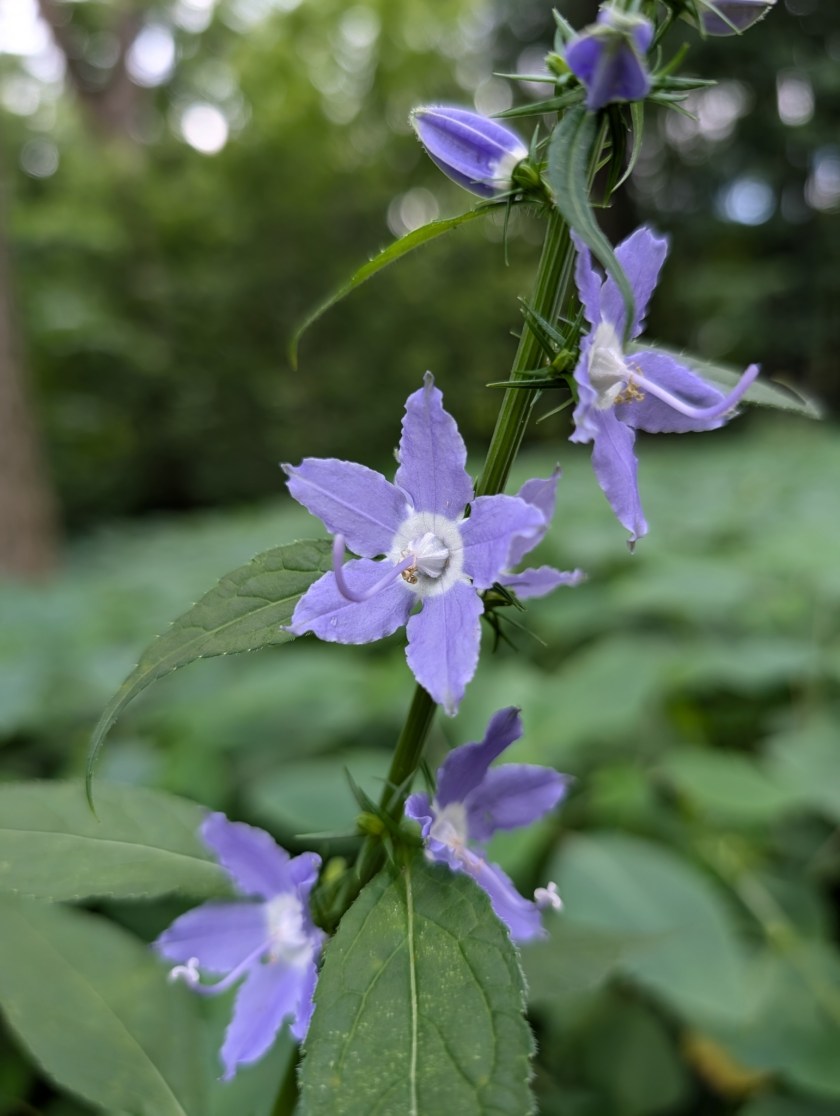
On the walk out, American bellflower is blooming in the St. Joseph Creek floodplain, alongside the wood nettles that are sparsely pimpled with midge galls. White bear sedge leaves are etched with Cerodontha tracks that run lengthwise and then diagonally to interconnect.
That night, fireflies streak through the hydrangeas and asters outside our front window. Cicadas call. The annual cicadas have picked up as they do this time every year. In a few weeks, the cicadas will give way to evening crickets just as the robins have passed the baton to the cardinals.
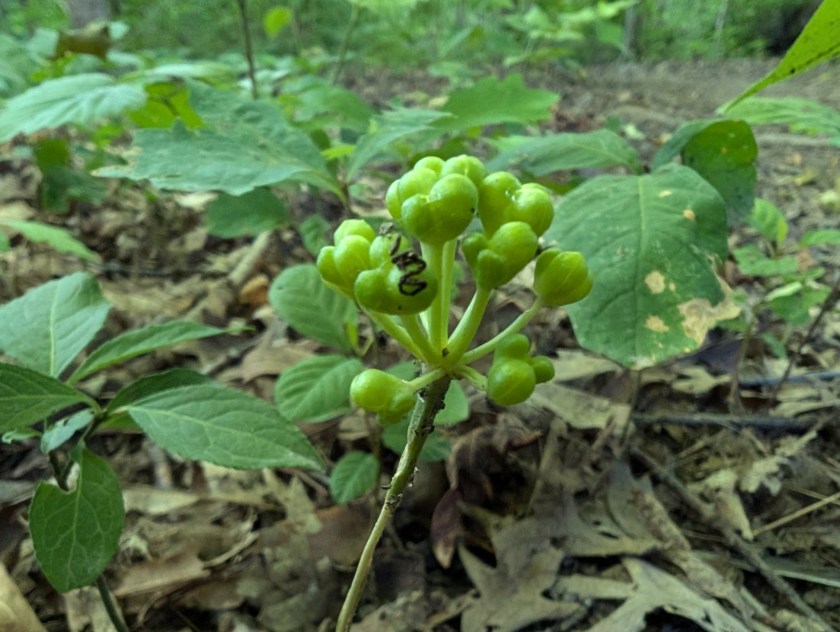
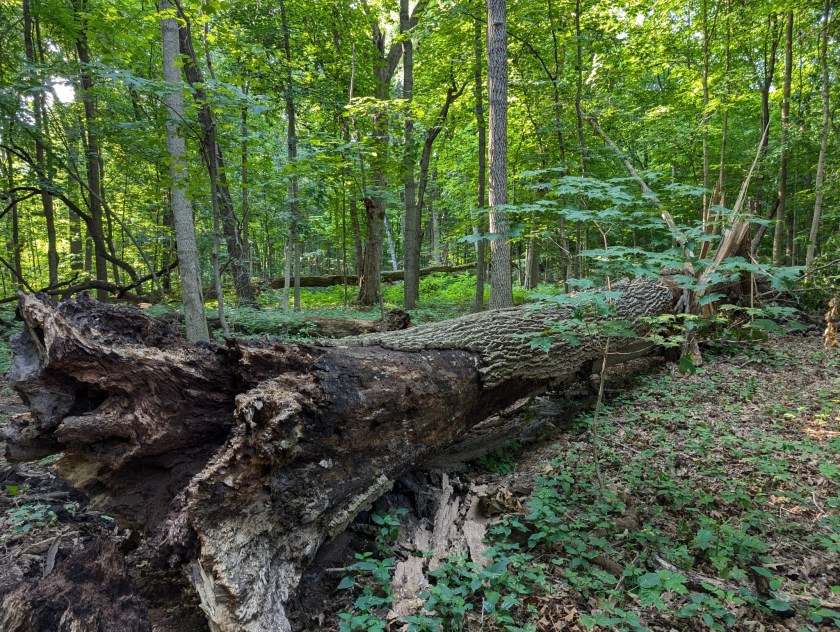
The morning of the 7th, I return to find wingstem about to come into flower, doll’s eyes fruits developing, an ash seedling tipped with a gall. Another giant ash tree has fallen, and the bark sloughing off reveals a reticulum of Armillaria rhizomorphs. The forest floor is strewn with the fallen tips of sugar maple branches withered off by the summer’s 17-year cicadas. White vervain is flowering. The first flowers of broad-leaved wild leek are fully open. Scanning the forest floor as I walk through, I am struck at the size and abundance of the colonies. This year may turn out to be the best show of Allium tricoccum that I’ve ever seen in Maple Grove.
Plants referenced
- Acer saccharum — sugar maple
- Actaea pachypoda — doll’s eyes, white baneberry
- Agrimonia gryposepala — common agrimony
- Allium burdickii — narrow-leaved wild leek
- Allium tricoccum — broad-leaved wild leek
- Campanulastrum americanum — American bellflower, tall bellflower
- Carex albursina — white bear sedge
- Carex cephalophora
- Circaea canadensis — enchanter’s nightshade
- Fraxinus americana — white ash
- Fraxinus sp. — ash. Everything I have run into in Maple Grove appears to be white ash, F. americana, but I’m not certain enough to say with fallen trees.
- Geum canadense — white avens
- Glyceria striata — fowl manna grass
- Laportea canadensis — wood nettles; note that the midge gall photo linked in this post is from the same population, but taken in 2020
- Lonicera maackii — Amur honeysuckle
- Phytolacca americana — American pokeweed
- Polygonum arenastrum / P. aviculare — sidewalk crack smartweed. These two species are treated as synonyms in Flora of North America, but separate species in Rericha and Wilhelm. I could not key this individual confidently to one over the other.
- Quercus alba — eastern white oak
- Verbesina alternifolia — wingstem
