


August 31, 2024
The St Joseph Creek bottomland at Maple Grove is still flooded with pale jewelweed flowers and fruits in a variety of stages: outcrossing flowers with petals spread wide; cleistogamous flowers closed tight; capsules slender and barely formed; others turgid, exploding at a brush. Bumble bees were foraging in the jewelweed canopy this evening. A few bees barely dipped their heads into the doorways of the open flowers before flying off, presumably because many flowers were already emptied of nectar. Most bees, however, landed on the floors of the corollas and slid inside like fingertips into thimbles. They brushed the floral ceilings with their backs on the way in, potentially releasing or depositing pollen, then they disappeared inside. For a second, only the tips of their hairy abdomens were visible as their probscises unrolled and dipped into the short nectary at the base of each flower. They collected what nectar they could, then they were off to the next.
Of this amble among the jewelweed flowers, Gerry Wilhelm and Laura Rericha write, “medium to large bees… lean into a corolla to glean nectar from the thick-walled nectar spur, and while doing so trip the anther ring, which causes pollen to fall down and coat the head and anterior thoracic region of the bee… Eventually the anther ring falls away and the once-concealed stigma becomes viscid and receptive… Flowering periodicity promotes pollination within a population, in that there are flowers of different ages that correspond to either the male or female phase of anthesis… Pollination is inevitable.” I see the flowering periodicity and how it helps the population along, but I’m afraid I don’t see how inevitable pollination is. If the system worked that perfectly, I suspect the species would dispense with the closed, cleistogamous flowers, which make the most sense as a fail-safe for plants that do not successfully get pollinated, or at least not often (more on this in my recent post on late-season jewelweed).
Smaller, slenderer bees were working the flowers as well, shining in the evening light. These slighter bees crept up the inner walls of the corollas rather than landing on the base and coming in upright. They were too small to scrape along the inner surface of the flowers, and thus they could not have made contact with the stigma. Likely they were swiping nectar or pollen. Laura and Jerry list a few bee species that take advantage in this way; from their short list, I have previously seen the pure green sweat bee at Maple Grove. I noticed about half as many small bees as bumble bees this evening, whether because they are less common or just less evident I don’t know.
Climbing false buckwheat is transitioning from flowering and fruiting, looping among the jewelweed leaves alongside the handrail on the south side of the bridge. On the west side of St. Joseph Creek, down the footpath that leads north between beds of white bear sedge etched with Cerodontha trails, a log that grew thick with stump puffballs this summer is frosted with honeycomb coral slime mold and capped with a colony of orange mycena that, as always, looks as bright as a bagful of candy (though this is not thought to be a tasty mushroom, and readers are advised not to try eating it).


I follow the trail over slopes clothed with dilapidated black snakeroot, wild ginger, and net-leaved, insect-eaten wood nettle. I pass a log I have been watching decompose for several years and find it flatter than it was last August. It is declining gracefully and still has years left to give back to the insects and fungi. I leave the trail, walk down through the woods, and encounter a lawn of Wood’s sedge, Carex woodii, about 20 feet in diameter. I visited this very patch on my birthday in 2019 but had forgotten about it. It looks exactly as it did 5 years ago, a picnic-sized blanket of soft green in the forest, each plant burgundy-based. This species is a CBG Plant of Concern, listed as rare in the state, but it is very happy in the few sites where I know it from Maple Grove and The Morton Arboretum (and apparently Lyman Woods, based on collections made in 1978 and 1979, and where the species played a role in the preservation of the forest, though I haven’t seen it there myself that I recall). It is locally abundant, but perhaps not all that common across our landscape.
I walk downslope another 30 feet, toward the slough that fills from the culvert beneath the trail before it runs in a ditch down toward the ephemeral Echinochloa wetland in the middle of the forest. The soil flanking the ditch is saturated and thick with poison ivy. Taperleaf waterhorehound is flowering along with arrow-leaved tearthumb. I am wearing shorts, so I move cautiously. Great blue lobelia is flowering in abundance. In the muck nearby, a couple of cardinal flowers are blooming. These two species have divvied up their portions of the bottomland: Lobelia siphilitica, the blue one, in the wet meadows alongside the trails and up where the soil is spongy; L. cardinalis, with brilliant red flowers, in the mud, sometimes right on the banks of the flowing water.


Upslope, a shaft of sunlight illuminates an orb-weaver’s web slung between a sugar maple sapling about as big around as my thumb and a neighboring maple tree about eight feet away. Struts run diagonally between the two trees, a broad span through which a coyote or deer or squirrel might run without thinking, or a botanist. Some of the capture spiral threads are torn, altogether missing or drooping against a neighboring strand. Some radii may need to be replaced. But somehow the web has made it through the day intact enough to catch the sun streaming in, and the spider is waiting in the middle.
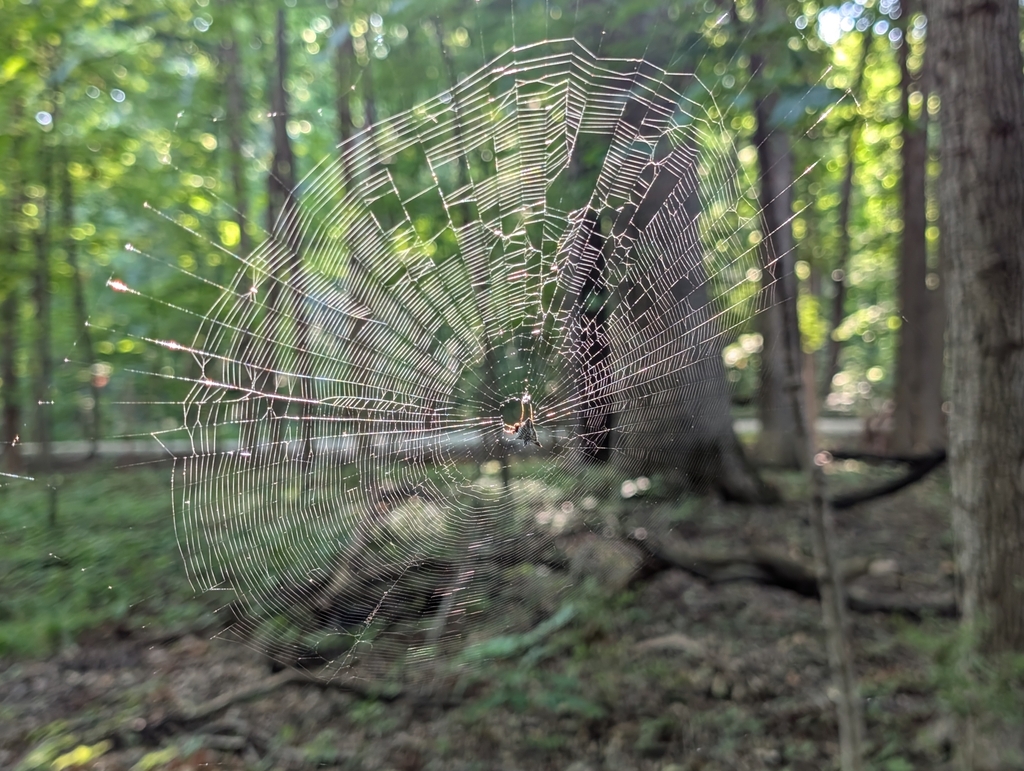
I move slowly, snapping photos as I approach. I can see now that she is a spined orb-weaver, Micrathena gracilis, a common spider but one I have only seen a couple of times before. Her abdomen is armed with thorns. When I am about three feet away, she dashes off to the upper frame of her web, from there up along one of the uppermost moorings to a branch running in from the nearby maple. She rests there until I leave.
Over the weekend, I will read that the spider I’ve seen likely rebuilt her spiral later in the evening, perhaps as Rachel and Louis and I were eating supper. I will read that she is in the right habitat: a spiny orb-weaver displaced to a conifer forest will disperse to a deciduous forest if she has half a chance, probably for reasons of the light environment. For if she is in the open, receiving too much light, the spider has to spend a greater portion of her day in the shade to avoid overheating, and this is a lost opportunity to feed. If she is compelled to make her web in the open, the spider will build her web facing the east and west, like a compass plant that avoids overheating by turning its edge toward the high noontime sun. Conversely, in the shadier forest, the spider will face her web toward the north and south. This is what the articles say, but my photo suggests this web was roughly facing the setting sun, westward in the shady forest. I will read that her spines may be a defense against predators, but that no one knows for sure.
And as I read, I will be reminded of Dylan Thomas’s litany of “useful” Christmas presents in A Child’s Christmas in Wales, closing with the “pictureless books in which small boys, though warned with quotations not to, would skate on Farmer Giles’s pond and did and drowned; and books that told me everything about the wasp, except why.” It is always like this: one person’s “why” devolves into a “how” or “what” in the next person’s hands. The spines are there, perhaps, because they defend the spider. That sounds like an answer to the question, “why?” But then the response: “So perhaps Micrathena defend themselves with spines… but why should they? Many other spiders don’t. Why not find a simpler way?”
There will never be an end to whys. Yet as I unlock my bike from the signpost buried at the edge of the floodplain, and as the cicadas wind down for the evening and the sun cants between the maples, I inhabit a universe of whats and whos. Bees patrol the flowers, pollinating or stealing as they see fit. Spiders perch in the middle of their webs, oriented whichever way strikes their fancy. Lobelias set up shop in wet forest and give each other as much room as they need. These are the things that I go out to find at 5 p.m. on a Saturday night and that I live among when I arrive home.

Plants referenced
- Acer saccharum — sugar maple
- Asarum canadense — wild ginger
- Carex albursina — white bear sedge
- Carex woodii — Wood’s sedge
- Fallopia scandens — climbing false buckwheat
- Impatiens capensis — pale jewelweed
- Laportea canadensis — wood nettle
- Lobelia cardinalis — cardinal flower
- Lobelia siphilitica — great blue lobelia
- Lycopus rubellus — taperleaf waterhorehound
- Persicaria sagittata — arrow-leaf tearthumb
- Sanicula sp. — black snakeroot
- Toxicodendron radicans — poison ivy
Sources
- Biere JM, Uetz GW. 1981. Web Orientation in the Spider Micrathena gracilis (Araneae: Araneidae). Ecology 62: 336–344.
- Bukowski TC, Christenson TE. 1997. Natural History and Copulatory Behavior of the Spiny Orbweaving Spider Micrathena gracilis (Araneae, Araneidae). The Journal of Arachnology 25: 307–320.
- Hodge MA. 1987a. Factors Influencing Web Site Residence Time of the Orb Weaving Spider, Micrathena gracilis. Psyche: A Journal of Entomology 94: 068503.
- Hodge M. 1987b. Macrohabitat Selection by the Orb Weaving Spider, Micrathena gracilis. Psyche 94.
- Magalhaes I, Santos A. 2012. Phylogenetic analysis of Micrathena and Chaetacis spiders (Araneae: Araneidae) reveals multiple origins of extreme sexual size dimorphism and long abdominal spines. Zoological Journal of the Linnean Society 166.
- Thomas D. 1969 [originally published 1954]. A Child’s Christmas in Wales. New Directions Publishing.
- Wilhelm G, Rericha L. 2017. Flora of the Chicago Region: A Floristic and Ecological Synthesis. Indiana Academy of Science.
The “why” in the plant world lead to endless speculation and investigation whether one is 8 or 80.
That’s the truth!
I never get tired of these walks in Maple Grove. Thanks.
Thank you, Nancy!